
Zygomatic Implants vs All-on-4: How to Tell Which You Need
All-on-4 anchors a fixed bridge on four implants placed in the jawbone; zygomatic implants anchor in the cheekbone instead, for people who no longer have enough jawbone for the standard approach. They are two techniques for two different amounts of remaining bone, and the choice between them is made by a scan rather than by preference. It is easy to read the usual sequence — All-on-4 first, zygomatic implants later — as a ranking. That is not what is happening. This page explains what All-on-4 actually is, the single measurement that usually decides the question, and why a surprising number of real cases end up using both.
- All-on-4 is an excellent option — for the right anatomy
- One measurement usually decides between the two
- Many real cases combine both, not either/or
 Medically reviewed by Uzm. Dt. Oğuzhan SunarSpecialist PeriodontistUpdated August 2026 · 9 min readWritten from 5 cited sources · clinical sign-off pendingPublished by Natural Clinic · how this guide is funded
Deciding factor
Bone at the front of the upper jawconfirmed on a CBCT scan, not by photo
Illustrative photography — not a patient of any clinic.
Deciding factor
Bone at the front of the upper jaw
confirmed on a CBCT scan, not by photo
All-on-4 anchorage
Four tilted implants in the jaw
Zygomatic anchorage
The cheekbone, above the jaw
Often the real answer
A combination of the two
subject to clinical assessment
What All-on-4 actually is
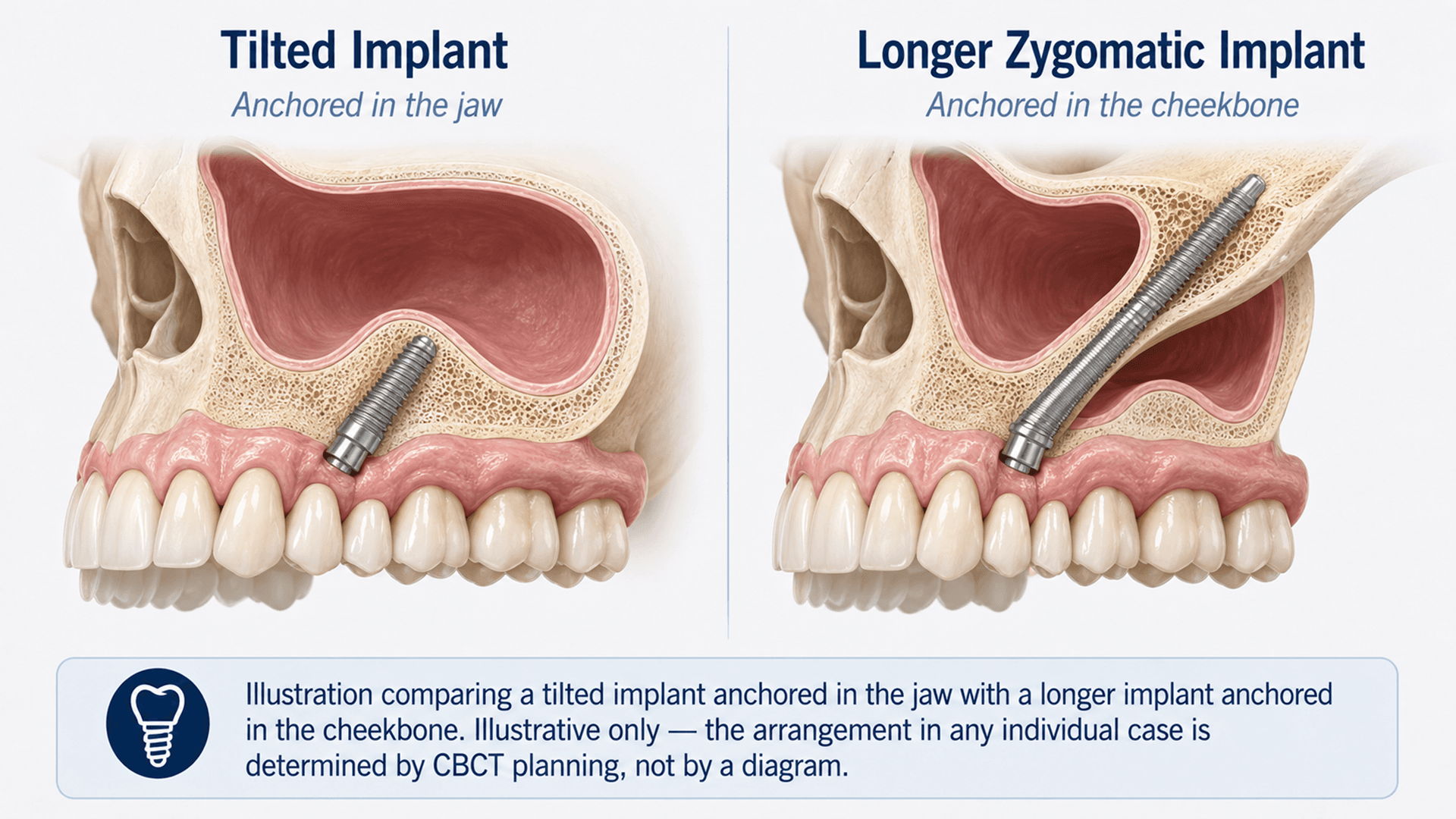
All-on-4 is a full-arch technique in which four implants are placed in the patient’s own remaining jawbone and together support one fixed bridge of teeth. The clever part is the angulation: the two implants at the back are deliberately tilted, typically leaning forwards, so that a longer implant can be driven through the denser bone available at the front and mid-arch rather than the thin, sinus-adjacent bone further back. Tilting buys length and spread without needing bone where there is none.
That spread matters because four implants have to behave as one unit. The bridge screwed onto them is rigid and crosses the whole arch, so chewing forces are shared rather than landing on any single implant. It is a genuinely elegant piece of engineering, and it is the reason the technique became a mainstream, well-established treatment offered by implant surgeons across the UK and internationally rather than a niche protocol.
People searching *what is All-on-4 dental implants* are often surprised by two things. The first is that it usually replaces a full arch of teeth with a fixed bridge, not four separate crowns. The second is that it is frequently done as a graftless procedure — one of its original selling points was avoiding the months of healing a bone graft requires. In both of those respects it has a lot in common with zygomatic treatment.
It is worth saying plainly, because a lot of content in this space implies otherwise: All-on-4 is not a lesser choice. Where the anatomy suits it, it is less invasive than cheekbone anchorage, more widely available, better supported by long-term published data, and normally less expensive. If a surgeon looks at your scan and says All-on-4 will work, that is good news, not a compromise.
The single factor that decides it
Almost every discussion of All-on-4 versus zygomatic implants comes down to one question: how much usable bone is left at the front of your upper jaw? Not the back — the back of the upper jaw is where bone disappears first, and both techniques are designed around that fact. The front, in the region under and either side of the nose, is where All-on-4 gets its grip. Take that away and the technique has nothing to work with.
Bone in the upper jaw exists to hold teeth. Once the teeth are gone the body gradually reclaims it, and long-term denture wear, gum disease, failed implants or a failed graft all accelerate the process. Meanwhile the sinuses tend to expand downwards into the space that opens up. In an upper jaw that has been edentulous for years, what remains at the back can be a thin shell. Whether anything usable survives at the front varies enormously from person to person, and it is not something you or your dentist can judge by looking.
That is why the honest version of this comparison is so short. If there is adequate bone at the front, tilted implants in your own jaw are a reasonable plan and All-on-4 is on the table. If there is not, no amount of tilting rescues it — the options become bone grafting to rebuild a foundation, or anchoring above the jaw entirely in the cheekbone, which is what a zygomatic implant does. Our guide to implant options with significant bone loss covers the full set of routes, grafting included.
Grafting deserves its own mention here rather than a dismissal. It is a well-evidenced, widely practised way of rebuilding bone so that conventional or All-on-4 implants become possible, and for many people it is the right answer. Its trade-off is time — months of healing before implants can be placed — and it needs a viable base to build on. Zygomatic treatment trades that healing time for greater surgical complexity and does not depend on the jaw. Neither is the villain of the story.
Where the anchorage comes from
A standard or tilted implant relies on the height and width of the upper jaw. A zygomatic implant passes that region and engages the cheekbone above it — which is why bone loss in the jaw does not rule it out.
All-on-4 and zygomatic implants side by side
Both are graftless full-arch approaches. What separates them is where the implants find bone, and therefore who they suit.
All-on-4
Best for: Enough usable bone remaining in the jaw, particularly at the front of the arch
- Implants
- 4 implants, the rear pair tilted
- Anchored in
- Your own jawbone
- Bone required
- Yes — moderate loss is workable
- Bone graft needed
- Usually not, by design
- Availability
- Widely offered in the UK and abroad
- Evidence base
- Longer and larger than for zygomatic work
Zygomatic implants
Best for: Severe upper-jaw bone loss, including cases refused for conventional implants
- Implants
- 1–2 zygomatic per side, often plus standard implants
- Anchored in
- The cheekbone (zygoma)
- Bone required
- None in the jaw itself
- Bone graft needed
- No — that is the point
- Availability
- Specialist centres only; far fewer surgeons
- Evidence base
- Established but smaller; dominated by hybrid cases
The comparison in full, including indicative cost
Figures below are indicative ranges gathered for comparison, not quotes, and the All-on-4 figures still need sourcing before publication. Your own price depends entirely on your scan and treatment plan, and a final price only follows a consultation.
Last updated: July 2026| Question | All-on-4 | Zygomatic (hybrid) | Quad zygomatic |
|---|---|---|---|
| Bone required in the upper jaw | Yes — usable bone at the front is essential | Only at the front; none needed at the back | None anywhere |
| Where the implants anchor | Jawbone, rear pair tilted | Cheekbone at the back, jawbone at the front | Cheekbone only, two per side |
| Bone graft needed | Usually avoided by design | No | No |
| Number of surgeries | Normally one surgical episode | Normally one surgical episode | Normally one surgical episode |
| Indicative UK cost | £15,000–£20,000 | £20,000–£28,000 | |
| Indicative cost in Turkey | from £5,500 | from £7,500 | |
| Who it typically suits | Mild to moderate bone loss with a solid front arch | Severe loss at the back, usable bone at the front | No usable jawbone left at all |
All zygomatic figures are indicative ranges rather than quotes; All-on-4 figures are deliberately left unfilled rather than estimated. "Number of surgeries" refers to implant placement only — a graft-first pathway adds a separate earlier surgery, and the final bridge is fitted at a later appointment in every case. Detail on costs: zygomatic implant costs · UK pricing · treatment in Turkey.
The hybrid reality: it is often not either/or
Here is the part most comparison pages leave out. In real treatment planning, the most common zygomatic arrangement is not four cheekbone implants replacing an All-on-4 — it is one zygomatic implant per side at the back, combined with two to four standard implants at the front of the jaw. Surgeons call this a hybrid case, and it is the default configuration wherever there is still usable bone at the front.
Look at that arrangement for a moment and you will notice something: the front half is essentially the All-on-4 principle, and the back half is zygomatic. The techniques are not opponents; they are components. A surgeon planning your arch is not choosing a brand, they are deciding, region by region, where load-bearing bone can be found — jaw at the front, cheekbone at the back, and in some plans the pterygoid region further back still, which our pterygoid implants page covers.
Only when the front of the jaw has nothing usable left does the plan become entirely cheekbone-anchored. That configuration — four zygomatic implants, none in the jaw — is described on our quad zygomatic implants page, and it is reserved for the most advanced cases rather than being the standard zygomatic option.
The practical consequence is that "All-on-4 or zygomatic?" is often the wrong question to arrive at a consultation with. A better one is: *given my scan, where does my usable bone actually sit, and what combination does that make possible?* A surgeon who answers that in specifics is planning treatment. One who answers with a package name is quoting a price list.
Signs the conversation may move beyond All-on-4
None of these confirms anything on its own, and none of them can replace a scan. They are simply the circumstances in which surgeons commonly find that tilted implants in the jaw are not enough.
- You have been told outright that there is not enough bone for implants in the upper jaw
- A clinic has proposed a sinus graft or block graft before implants can be considered
- You have worn an upper denture for many years, particularly a full one
- Previous implants in the upper jaw have failed, or a previous graft has failed
- Advanced gum disease has affected bone across the whole arch rather than one area
- Your upper denture has never felt stable regardless of how often it has been relined
- Bone was lost through trauma, a cyst, or reconstructive surgery
The questions that come next
Four things people reliably ask once the basic comparison is clear — including the All-on-6 question, which is one of the most searched comparisons in this area.
All-on-4 vs All-on-6 — does the number matter?
Can I have All-on-4 if I have already been refused implants?
Is All-on-4 quicker or easier to recover from?
What about my lower jaw?
Weighing the two honestly
Assuming for a moment that your anatomy allowed either — which is usually not the case — this is the trade-off.
Points in favour of All-on-4
- Less invasive surgery, confined to the jaw
- Longer and larger published evidence base
- Available from many more surgeons, in the UK and abroad
- Normally lower cost than a zygomatic plan
- Follow-up and any future servicing is easier to arrange locally
Points in favour of zygomatic implants
- Works when there is no usable bone left for jaw-anchored implants
- Avoids grafting and the months of healing it requires
- Anchors in bone that does not shrink after tooth loss
- Can reach patients who have been refused every other implant option
- Places support further back in the arch, which affects how the bridge is loaded
What to ask before accepting either plan
Ask these of any clinic, UK or overseas, and expect specific written answers rather than reassurance.
- 1Have you assessed my CBCT scan, and can you show me where the usable bone is?
- 2Is All-on-4 possible in my case, and if not, exactly which measurement rules it out?
- 3If All-on-4 is not possible, what are my options — grafting, a hybrid zygomatic plan, or fully cheekbone-anchored?
- 4Is the plan you are quoting me four implants, six, or a combination — and why that configuration?
- 5What happens, and what does it cost, if the plan has to change during surgery?
- 6Who would place any zygomatic implants, how many such cases do they complete a year, and who manages complications?
- 7What exactly does the quoted price include, and what is excluded?
Zygomatic implants vs All-on-4: common questions
What is All-on-4 dental implants?
Is All-on-4 worse than zygomatic implants?
How do I know which one I need?
How much do All-on-4 dental implants cost in the UK and Turkey?
What is the difference between All-on-4 and All-on-6?
Can zygomatic implants and All-on-4 be combined?
Do zygomatic implants work in the lower jaw?
How we reviewed this page
Written by the ZygomaticImplant.net editorial team and checked against the published literature. What we accept as a source, the difference between a page that is cited and one that is clinically signed off, and how we handle corrections are all set out in our editorial standards.
- First published
- 10 August 2026
- Last revised
- 21 August 2026
- Cited sources
- 5
- Clinical sign-off
- Pending · 23 statements queued
Sources & references
- [1]Uesugi T, Shimoo Y, Munakata M, Sato D, Yamaguchi K, Fujimaki M, et al. The All-on-four concept for fixed full-arch rehabilitation of the edentulous maxilla and mandible: a longitudinal study in Japanese patients with 3–17-year follow-up and analysis of risk factors for survival rate. Int J Implant Dent. 2023;9:43. Followed 561 patients and 2,364 implants: cumulative survival 97.4% at implant level in the maxilla and 98.9% in the mandible. Critically for this comparison, the maxilla itself was the strongest risk factor for failure (OR 5.68 at implant level), and most failures occurred within the first 24 months.
- [2]Al-Nawas B, Aghaloo T, Aparicio C, et al. ITI consensus report on zygomatic implants: indications, evaluation of surgical techniques and long-term treatment outcomes. Int J Implant Dent. 2023;9:28. Mean zygomatic implant survival 96.2% over a mean 6.3-year follow-up. Zygomatic implants are "mainly indicated in cases with maxillary bone atrophy or deficiency" — that is, the situations in which a jaw-anchored All-on-4 is least predictable.
- [3]Lorusso F, Conte R, Inchingolo F, Festa F, Scarano A. Survival Rate of Zygomatic Implants for Fixed Oral Maxillary Rehabilitations: A Systematic Review and Meta-Analysis Comparing Outcomes between Zygomatic and Regular Implants. Dent J (Basel). 2021;9(4):38. Reports a 12-year cumulative survival rate of 95.21% across 4,556 zygomatic implants, and lower failure for zygomatic than conventional implants in the compared samples (0.69% vs 2.89%).
- [4]Cucchi A, Maiani F, Franceschi D, Sassano M, Fiorino A, Urban IA, Corinaldesi G. The influence of vertical ridge augmentation techniques on peri-implant bone loss: A systematic review and meta-analysis. Clin Implant Dent Relat Res. 2024;26(1):15–65. Combined healing complication rate 15.9% and mean vertical bone gain 5.26 mm — the grafting route this comparison weighs against a graftless one.
- [5]Tallgren A. The continuing reduction of the residual alveolar ridges in complete denture wearers: a mixed-longitudinal study covering 25 years. J Prosthet Dent. 1972;27(2):120–132.
- [6]All-on-4 versus All-on-6 — comparative literature on implant number and load distribution. Citation still required.pending confirmation
- [7]UK and Turkey price ranges for All-on-4, zygomatic and quad zygomatic treatment — indicative figures compiled from advertised clinic prices, not an independent fee survey.pending confirmation
- [8]Anaesthesia and invasiveness comparison between jaw-anchored and zygomatic full-arch surgery — indicative protocol, not yet confirmed in writing by the clinic.pending confirmation
- [9]This page is for information only and is not a substitute for professional medical advice, diagnosis or treatment. Some clinical statements are still awaiting sign-off by our medical reviewer.
The next step is a scan, not a decision
Upload a panoramic X-ray or CT scan and a specialist will tell you what is actually possible in your case — in writing, with no obligation.
Medically reviewed · Free · No pressure, no spam


