
Teeth in a Day With Zygomatic Implants: What It Really Means
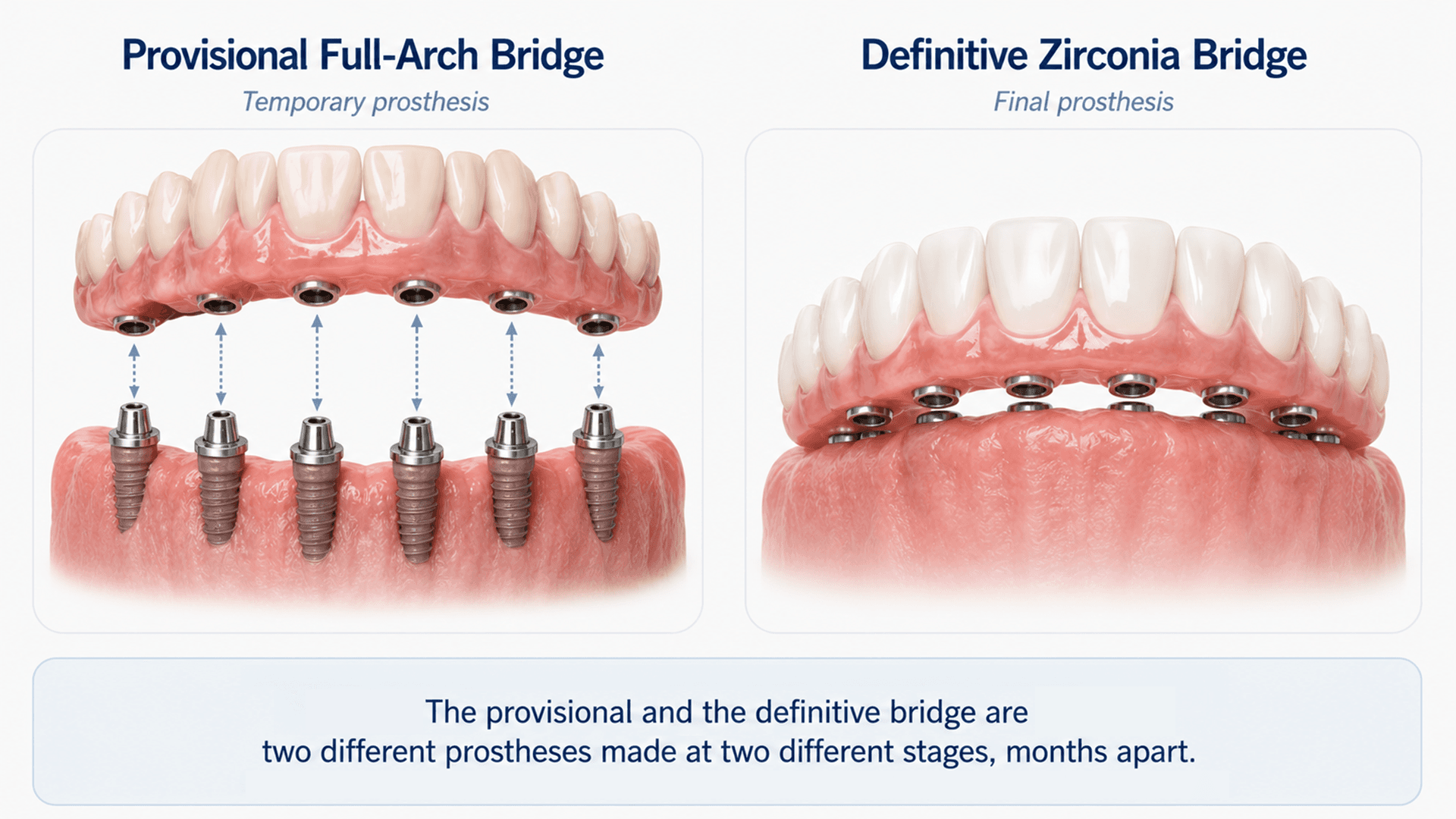
“Teeth in a day” means a fixed temporary bridge attached within days of surgery — not the finished teeth, which are made months later once the implants have integrated. Few phrases in implant dentistry do as much work, and few are as widely misread. Understanding the difference before you book is genuinely important, because it changes what you expect on the day, what you can eat for months afterwards, and how many trips you make if you are treated abroad. This page is not here to sell you the speed. It explains what happens, why it is possible at all with cheekbone-anchored implants, and where the marketing tends to blur.
- What you leave with is a provisional, not the final bridge
- Why cheekbone anchorage allows immediate loading
- The two-trip reality if you are treated abroad
 Medically reviewed by Uzm. Dt. Oğuzhan SunarSpecialist PeriodontistUpdated August 2026 · 9 min readWritten from 3 cited sources · clinical sign-off pendingPublished by Natural Clinic · how this guide is funded
What is fitted first
A fixed provisional bridgenot the definitive teeth
Illustrative photography — not a patient of any clinic.
What is fitted first
A fixed provisional bridge
not the definitive teeth
Typical timing
Within about 24–72 hours
indicative protocol
Final bridge
After roughly 4–6 months
indicative, varies by patient
Trips if treated abroad
Usually two
indicative travel plan
What "teeth in a day" actually delivers
The accurate clinical term for what happens is immediate loading: implants are placed and a prosthesis is attached to them straight away rather than leaving them to heal untouched under the gum. In a zygomatic full-arch case that prosthesis is a rigid, screw-retained bridge covering the whole upper arch, fixed in place so you cannot remove it and neither can you take it out at night.
That is a real and meaningful thing. You do not spend the integration period in a removable denture, you do not go through a period with no teeth at all, and you leave the clinic able to speak and eat something. For someone who has worn a loose upper denture for years, or who has been told nothing can be done, that alone changes daily life considerably.
What it is not is finished dentistry. A provisional bridge is built quickly, from materials chosen for speed and adjustability rather than longevity, and it is designed to be replaced. The definitive bridge — commonly a monolithic zirconia one — comes later, after the implants have bonded with the cheekbone and the soft tissues have settled into their final shape.
Both stages matter, and the second one is where the aesthetics and the fit are properly resolved. If you take one thing from this page, take this: the day of surgery is the beginning of the treatment, not the end of it. Our procedure guide walks through the full sequence.
The timeline in numbers
Why immediate loading is possible at all
Loading an implant immediately is not standard practice everywhere, and for good reason. A conventional implant placed in soft or thin bone needs to be left alone while bone grows onto its surface; put chewing forces through it too early and you risk micromovement at the interface, which can prevent integration altogether. That is why many implant plans still involve months in a temporary denture before anything is screwed on.
Cheekbone anchorage changes the mechanics. The zygoma is part of the facial skeleton rather than tooth-bearing bone — its job is to carry chewing load and protect the eye socket — and it is largely dense cortical bone. Dense cortical bone gives an implant an immediate mechanical grip at the moment of placement, described as primary stability, and it is that initial stability rather than healing that makes attaching a bridge straight away defensible.
The second half of the explanation is the bridge itself. Individual implants are not immediately loaded in isolation here; all of them are joined into one rigid cross-arch framework. Splinting them together means force applied at one point is distributed across every anchor rather than levering a single fixture, which is why the provisional has to be fixed and rigid rather than a comfortable soft temporary.
It is worth being clear about what this does and does not mean. Immediate loading is possible in suitable cases — it is not automatic, not universal, and it is a decision the surgeon makes with the implants in front of them. The background to why cheekbone bone behaves this way is covered in our complete guide to zygomatic implants.
What generally has to be true for immediate loading
These are the conditions surgeons look for before attaching a bridge straight after placement. Every one of them is assessed case by case.
- CBCT planning shows cheekbone anatomy adequate for the planned implant positions
- Good primary stability is achieved for every implant at the time of placement
- Enough implants are placed, and spread widely enough, to splint into one rigid arch
- The bite can be adjusted so forces are distributed rather than concentrated
- General health and healing capacity support loading rather than a staged approach
- The patient understands and accepts the diet and care restrictions that follow
- The surgical and laboratory team can produce a fitted provisional within the planned window
Who is usually not a candidate for same-day loading
Immediate loading is a clinical judgement, and there are recognised reasons for staging treatment instead. The factors below are the ones that typically prompt caution — none is a fixed rule, and only your surgeon can apply them to your case.
Implants that do not achieve enough primary stability
Active infection in the surgical area
Uncontrolled systemic conditions affecting healing
A history of certain bone medications or radiotherapy
Heavy smoking or a very heavy bite
Cases where the plan has to change during surgery
What the provisional bridge is actually like to live with
Expect it to look better than what you had and not as good as what is coming. A provisional is typically an acrylic bridge on a reinforcing framework — quick to make, easy to adjust, and deliberately not the finished article. Shade, tooth shape and the way the bridge meets your gum line are all refined later, so small aesthetic compromises at this stage are normal rather than a sign something has gone wrong.
Physically, the first weeks are dominated by surgery rather than by the bridge: swelling across the cheeks, bruising, a blocked or congested feeling, and tenderness. Speech usually takes some adjusting to, because the bridge is thicker in places than natural teeth and the implant heads in a zygomatic case tend to emerge further back and more towards the palate than you might expect. Most people find this improves over weeks. Our recovery guide sets out the healing timeline in more detail.
Cleaning is different too. You cannot take the bridge out, so hygiene happens around and under it, with interdental brushes, water flossing and whatever technique your clinic demonstrates before you leave. Getting this right is not cosmetic housekeeping — soft-tissue health around the implants matters for the outcome, and it is far harder to fix bad habits later than to learn good ones now.
And it is a temporary, which means it can chip, a screw can loosen, and it may need adjusting during the integration period. Ask before you travel who handles that, where, and at whose cost — particularly if the clinic is in another country.
The realistic sequence, start to finish
Outline of a typical immediately loaded zygomatic pathway. Every interval below is indicative rather than confirmed, and varies by patient and by clinic.
- 1
Remote review and planning
A panoramic X-ray or CBCT is reviewed, a preliminary plan is discussed, and it is established whether immediate loading is plausible in your case. Plausible is the strongest word available at this stage.
- 2
Arrival, examination and CBCT
An in-person examination and a scan taken on site confirm the anatomy and finalise implant positions. The provisional bridge design is prepared around that plan.
- 3
Surgery
Implants are placed, typically under general anaesthesia or deep sedation, with operating times commonly quoted in the region of two to four hours. Primary stability is assessed implant by implant.
- 4
Fixed provisional bridge fitted
Where stability allows, the provisional is attached and adjusted — commonly described as within about 24–72 hours of surgery. This is the stage marketed as "teeth in a day".
- 5
Discharge checks and travel home
Bite adjustment, hygiene instruction, written aftercare and medication before you leave. If you were treated abroad, this is also where you agree how reviews will happen remotely and who to contact if something goes wrong at home.
- 6
Integration period
Roughly four to six months in typical protocols, worn on the provisional bridge, with reviews continuing throughout. Healing is individual and no fixed timeline can be promised in advance.
- 7
Final bridge — the second trip
New impressions or scans, then the definitive bridge, commonly monolithic zirconia, is made and fitted. For patients treated abroad this normally means travelling again.
What a headline "teeth in a day" price tends to leave out
One of the most-searched phrases in this area is "cheapest teeth in a day" — and it is worth being blunt about why headline figures vary so much. Often they are not describing the same treatment. A price advertised for same-day teeth might cover four standard implants in an arch with reasonable bone, which is a very different procedure, and a very different cost base, from cheekbone-anchored implants placed under general anaesthesia in a jaw with almost nothing left.
The other reason is scope. A low headline number frequently prices the surgery and the provisional bridge, while the definitive bridge — the one you will actually live with for years — sits in a second stage that is quoted separately or not mentioned at all. Since that second stage is where much of the laboratory work and cost sits, a comparison that includes it for one clinic and not another is not a comparison.
None of this means a lower price is dishonest. It means you have to compare like with like, in writing, before deposits change hands. Ask for a single itemised quote covering both stages, and ask what falls outside it. Our cost guide and the Turkey page go through this in more detail, and our UK pricing page covers the domestic comparison.
Checking what a same-day quote covers
Use this as a checklist against any written quote, UK or overseas. We are deliberately not publishing a price for same-day treatment here, because we do not yet hold a sourced figure we would stand behind.
Last updated: July 2026| Item | Usually in a headline price | Frequently extra or unstated |
|---|---|---|
| CBCT scan and treatment plan | Sometimes, sometimes free remotely | Charged separately in some UK practices |
| Implant surgery | Yes | — |
| General anaesthesia or sedation | Sometimes | Often an add-on, worth confirming |
| Fixed provisional bridge | Usually — this is the "teeth in a day" part | — |
| Definitive final bridge | Not always | Commonly a separate second-stage cost |
| Additional implants if the plan changes | No | Almost always extra — agree the rate in advance |
| Review appointments during integration | Sometimes | Remote reviews may be included, in-person ones not |
| Adjustments or repairs to the provisional | Rarely stated | Ask specifically, especially if treated abroad |
| Flights, accommodation and transfers | Varies by package | Flights are typically excluded |
| Second trip for the final bridge | Rarely priced upfront | Budget for travel twice |
Indicative structure only, compiled for comparison — not a quote and not a description of any particular clinic. Inclusions differ between providers and countries; get yours itemised in writing before paying anything.
The honest balance of immediate loading
Weighed properly rather than sold.
What it gives you
- You leave with fixed teeth rather than a removable denture or no teeth
- One surgical episode instead of a staged placement and later exposure
- Speech and eating are possible during the integration period
- Soft tissues heal around a fixed shape from the start
- For long-term denture wearers, an immediate change in daily function
What it asks of you
- What you receive is a provisional, and the final bridge is months away
- Real diet restrictions for the whole integration period
- Hygiene around a fixed bridge you cannot remove takes learning
- It cannot be guaranteed in advance — stability on the day decides it
- The provisional can chip or loosen, which is awkward if the clinic is abroad
- Two trips, and two lots of travel cost, if treated overseas
Questions to ask before you book same-day teeth
Specific written answers, not reassurance. These work equally well for a clinic in London and one in Istanbul.
- 1Is what I receive on the day a provisional bridge or my final bridge?
- 2When would the definitive bridge be fitted, and is it included in the price you have quoted?
- 3What happens if the implants do not achieve enough stability for immediate loading?
- 4What exactly can and cannot I eat, and for how long — in writing?
- 5Who adjusts or repairs the provisional if there is a problem after I get home, and at whose cost?
- 6How many reviews are included during integration, and are they remote or in person?
- 7If I am treated abroad, how many trips does the full treatment involve and what is excluded from the package?
Searching for “teeth in a day near me”
City searches for this are common — London, Manchester, Birmingham, Liverpool, Leeds, Cardiff — and they mostly return practices offering same-day teeth on standard implants, which is a different proposition from same-day teeth on zygomatic implants in a jaw with no usable bone. Both are called “teeth in a day”.
So the useful question is not who advertises it nearby, but whether the team can do it in your anatomy. If you have been told there is not enough bone, a local practice offering same-day teeth on conventional implants may not be able to help — and should say so rather than try.
Provision for the zygomatic version is concentrated in a small number of centres; the honest national picture is in your options in the UK, and the way to vet any provider is in how to find a surgeon.
Teeth in a day: common questions
Does "teeth in a day" mean I get my final teeth in one day?
Why can zygomatic implants be loaded immediately?
How long until I get the final bridge?
What can I eat with the provisional bridge?
Is everyone a candidate for same-day teeth?
Why do "cheapest teeth in a day" quotes vary so much?
If I have same-day implants in Turkey, do I still need to travel twice?
Can I get teeth in a day near me?
How we reviewed this page
Written by the ZygomaticImplant.net editorial team and checked against the published literature. What we accept as a source, the difference between a page that is cited and one that is clinically signed off, and how we handle corrections are all set out in our editorial standards.
- First published
- 10 August 2026
- Last revised
- 21 August 2026
- Cited sources
- 3
- Clinical sign-off
- Pending · 38 statements queued
Sources & references
- [1]Al-Nawas B, Aghaloo T, Aparicio C, et al. ITI consensus report on zygomatic implants: indications, evaluation of surgical techniques and long-term treatment outcomes. Int J Implant Dent. 2023;9:28. Reports that immediate loading showed a statistically significant increase in survival over delayed loading — 98.1% versus 95% — alongside overall mean survival of 96.2% at a mean 6.3-year follow-up.
- [2]Brennand Roper M, Vissink A, Dudding T, Pollard A, Gareb B, Malevez C, et al. Long-term treatment outcomes with zygomatic implants: a systematic review and meta-analysis. Int J Implant Dent. 2023;9:21. Pooled 18 studies covering 1,349 zygomatic implants in 623 patients: immediate loading 98.1% versus delayed 95%, annual failure incidence 0.7%, and first-year failure 2%.
- [3]Lorusso F, Conte R, Inchingolo F, Festa F, Scarano A. Survival Rate of Zygomatic Implants for Fixed Oral Maxillary Rehabilitations: A Systematic Review and Meta-Analysis Comparing Outcomes between Zygomatic and Regular Implants. Dent J (Basel). 2021;9(4):38. Reports a 12-year cumulative survival rate of 95.21% across 4,556 zygomatic implants.
- [4]Provisional bridge timing (approximately 24–72 hours), operating time (approximately 2–4 hours) and integration period (approximately 4–6 months) — indicative protocol, not yet confirmed in writing by the clinic.pending confirmation
- [5]Provisional and definitive prosthesis materials — clinic protocol, not yet confirmed in writing.pending confirmation
- [6]Contraindications and cautions for immediate loading, including infection, systemic conditions, antiresorptive medication and radiotherapy — dedicated citation still required.pending confirmation
- [7]Dietary guidance during the integration period — clinic aftercare instructions, not yet confirmed in writing.pending confirmation
- [8]Same-day full-arch price ranges and quote inclusions — deliberately left unpriced rather than estimated.pending confirmation
- [9]Two-trip treatment structure and package inclusions for treatment abroad — indicative travel plan, not yet confirmed in writing by the clinic.pending confirmation
- [10]This page is for information only and is not a substitute for professional medical advice, diagnosis or treatment. Some clinical statements are still awaiting sign-off by our medical reviewer.
The next step is a scan, not a decision
Upload a panoramic X-ray or CT scan and a specialist will tell you what is actually possible in your case — in writing, with no obligation.
Medically reviewed · Free · No pressure, no spam


