
Dentures vs Zygomatic Implants: Making the Switch
Three different treatments hide behind searches like “denture implants”: a conventional denture that rests on your gums, an implant-retained denture that clips onto implants and still comes out at night, and an implant-supported bridge that is fixed in place and does not come out at all. Zygomatic implants are one way of supporting that fixed bridge when the upper jaw has too little bone left. Sorting out which is which is the main job of this page, because you cannot compare costs, comfort or commitment until you know what you are comparing. We are not going to tell you that everybody should have surgery. For some readers, a well-made denture remains the right answer.
- Retained vs supported — the difference nobody explains
- What actually changes at mealtimes
- When keeping your denture is the right call
 Medically reviewed by Uzm. Dt. Oğuzhan SunarSpecialist PeriodontistUpdated August 2026 · 11 min readWritten from 4 cited sources · clinical sign-off pendingPublished by Natural Clinic · how this guide is funded
Conventional denture
Removable, gum-borne
Illustrative photography — not a patient of any clinic.
Conventional denture
Removable, gum-borne
Implant-retained
Clips on, still comes out
Implant-supported
Fixed, stays in place
Cost figures here
Indicative
verify before relying on them
Three different things, one confusing search term
The phrase "denture implants" gets used loosely by clinics, forums and even dental receptionists, and it can mean any of three quite different treatments. The confusion is not your fault, but it does have consequences: people book consultations expecting one thing and are quoted for another, or compare a UK price for a removable option against an overseas price for a fixed one and conclude, wrongly, that one clinic is fleecing them.
The clean way to think about it is to ask two questions of any option you are shown. First: what holds it in place — your gums and palate, or implants anchored in bone? Second: does it come out — can you (and must you) remove it for cleaning, or is it screwed in and removed only by a clinician? Those two questions separate the three routes completely, and they are the questions to put to any clinic that quotes you a figure.
Everything on this page is general background about the options, not an assessment of your mouth. Which of these routes is realistic for you depends on how much bone you have, the health of your gums, your general health and your own priorities — a judgement for the clinicians examining you and your scans.
Conventional, implant-retained, implant-supported
The three routes side by side. Terminology varies between practices, so always confirm in writing which one a quote refers to before comparing prices.
Conventional denture
Best for: Best when surgery is unsuitable, unwanted, or not yet the right time
- What holds it in
- Your gum ridge, the shape of your palate, suction and — for many wearers — adhesive
- Comes out?
- Yes, removed for cleaning and usually overnight
- Surgery involved
- None, beyond any extractions you may already need
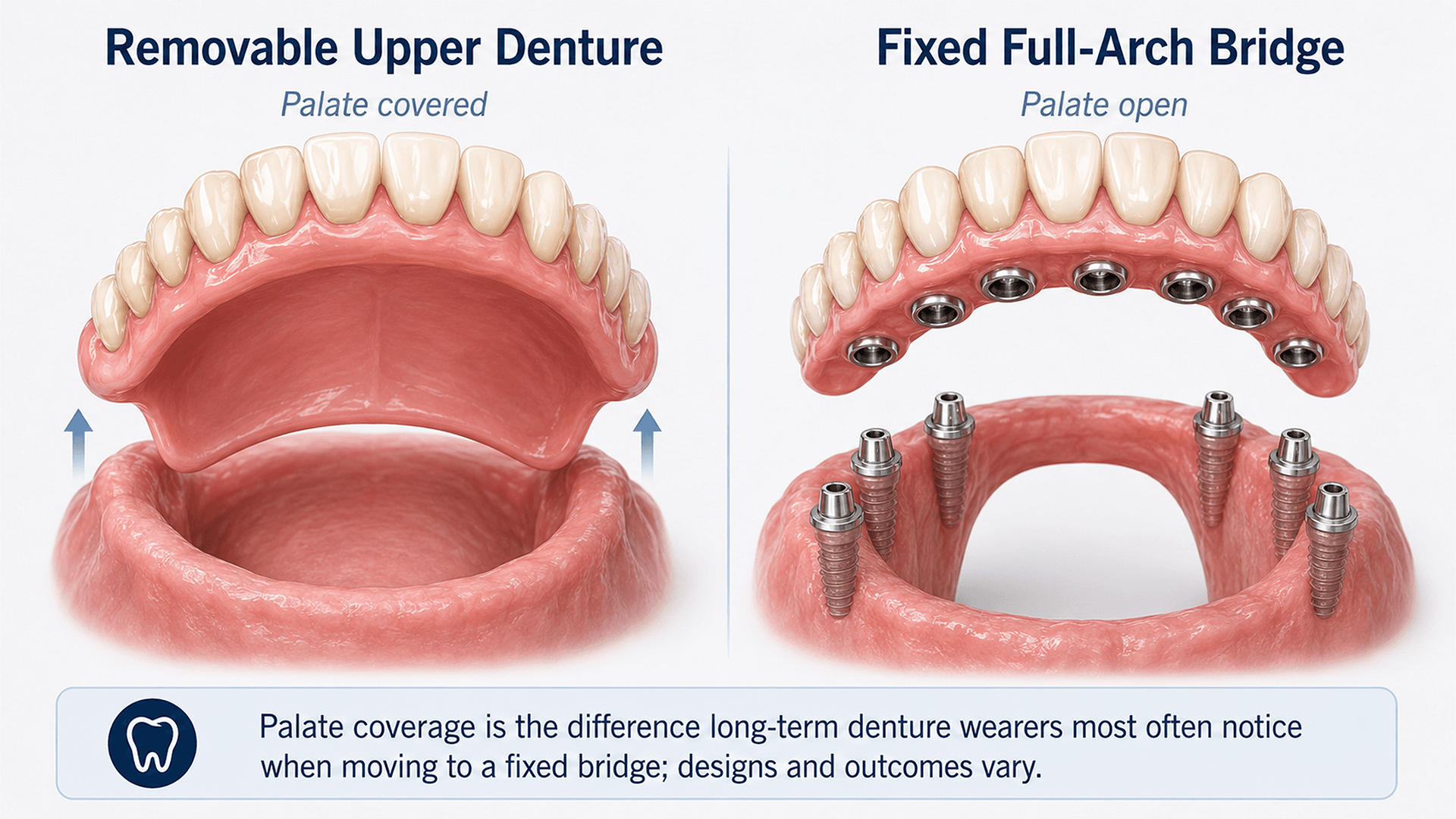
- Palate covered
- Yes, on an upper denture — which is what most affects taste and the feel of hot and cold food
- Effect on bone
- Does not stimulate the jaw bone; long-term wear is associated with continuing ridge resorption
- Typical honest downside
- Movement when chewing or laughing, adhesive dependence, and a fit that changes as the ridge changes
Implant-retained denture
Best for: Best for a big stability gain with fewer implants and less surgery
- What holds it in
- A small number of implants with clips, locators or a bar; the gums still share the load
- Comes out?
- Yes — you unclip it yourself for cleaning. This surprises people who assumed "implants" meant fixed
- Surgery involved
- Implant placement, with numbers and positions decided on your scan
- Palate covered
- Often still covered on an upper denture, though designs vary
- Effect on bone
- Implants need adequate bone to be placed at all, which is precisely the obstacle many long-term denture wearers hit
- Typical honest downside
- Clips and attachments wear and need replacing periodically; it is a maintenance item, not a fit-and-forget solution
Implant-supported fixed bridge
Best for: Best for people who want teeth that never come out — where anatomy and health allow
- What holds it in
- Implants alone. On upper arches with severe bone loss this may mean zygomatic implants anchored in the cheekbone
- Comes out?
- No — removed only by a clinician, at reviews
- Surgery involved
- The most, including longer procedures under sedation or general anaesthesia for zygomatic cases
- Palate covered
- No — the palate is left open, which is the change most patients comment on first
- Effect on bone
- Load is carried by bone rather than the gum ridge; zygomatic protocols are designed for arches where ridge bone is already largely gone
- Typical honest downside
- Highest cost, real surgical risk, and demanding hygiene around a bridge you cannot take out — see our risks guide
The loop most of our readers are living in
There is an uncomfortable circularity to denture wearing that rarely gets explained at the point when it would be most useful. When natural teeth are lost, the bone that once held them is no longer being loaded through tooth roots, and the jaw ridge gradually reduces in volume — a process usually described as resorption. A conventional denture rests on that ridge rather than stimulating it, and long-term denture wear is associated in the clinical literature with continuing ridge reduction rather than with preserving it.
The practical consequence arrives years later. The denture that fitted well in year two becomes loose in year eight, needs more adhesive, gets relined, and eventually reaches the point where there is not enough ridge left to hold anything reliably. And at exactly that moment, when someone finally asks about implants, they are told there is not enough bone for standard implants to be placed. Many of the people reading this page have had that conversation, sometimes more than once.
That is the loop: the treatment that was offered because teeth were lost contributes over time to the bone loss that later narrows the options. Saying so is not a criticism of dentures or of the dentists who provided them — for decades they were often the only realistic option, and for many people they have worked well. But it explains why the upper jaw in particular can end up with so little usable bone, and why techniques that anchor outside the ridge exist at all. Our guide to implants with bone loss covers the anatomy in more detail.
The important corollary: being told "no bone, no implants" by one dentist is a statement about standard implants in the ridge. It is not automatically the end of the conversation, because zygomatic and pterygoid techniques deliberately bypass that ridge. Equally, it does not mean you are a candidate — only a clinical assessment and a CBCT scan can establish that.
What actually changes day to day
The differences people notice are rarely the ones in the brochure. This is a general picture drawn from what patients commonly report, not a promise about your experience.
Last updated: July 2026| Everyday thing | Conventional denture | Implant-retained (removable) | Implant-supported (fixed) |
|---|---|---|---|
| Biting into an apple or a sandwich | Often avoided — front-tooth biting tends to lever the denture | Usually easier, though the gums still share load | Generally the closest to natural function once healed and cleared by your clinician |
| Chewing tougher food | Commonly limited; many wearers quietly narrow their diet over years | Improved stability commonly reported | Widest range, reintroduced gradually — see recovery |
| Taste and temperature | Palate coverage dulls taste and the sensation of hot and cold for many wearers | Often still partly covered, depending on design | Palate left open, which patients frequently describe as the biggest surprise |
| Speech | Bulk and movement can affect certain sounds; adaptation varies | Improved stability usually helps | A short adaptation period is common while the tongue learns a fixed bridge |
| Adhesive | Widely used and, for some, a daily cost and a daily worry | Usually not needed once clips are working well | Not applicable |
| Cleaning | Out at night, brushed and soaked | Unclipped and cleaned, plus cleaning around the implant attachments | Cannot be removed — cleaning under and around the bridge with brushes or an irrigator becomes essential |
| Confidence in public | The fear of movement while laughing, coughing or eating out is one of the most commonly reported burdens | Commonly reduced | Commonly reported as the main reason people pursued it, though outcomes vary between individuals |
| Maintenance appointments | Relines and remakes over time | Clip and attachment replacement, plus hygiene reviews | Hygiene reviews, screw checks, and eventual prosthesis maintenance |
Patient-reported differences described in general terms. Individual experience varies considerably, and none of this is a prediction for your case.
Making the switch: honest advantages and honest trade-offs
Weighed against staying with a well-made conventional denture. Both columns are real, and the second column is the one clinics tend to skip.
What people gain
- Teeth that are not held in by suction or adhesive, and do not move when you laugh
- An open palate on fixed upper bridges, which many patients say changes eating more than chewing strength does
- A wider practical diet, reintroduced on clinical advice rather than all at once
- For fixed options, no nightly routine of removal and soaking
- Load carried through bone rather than resting on a shrinking ridge
- For people who have been told standard implants are impossible, an option that does not depend on ridge bone
What it costs them
- Real surgery with real risks, including sinus and nerve considerations for zygomatic cases — read the risks guide before deciding anything
- A significant up-front cost, and a treatment that usually spans months rather than weeks
- Demanding daily hygiene around a bridge you cannot take out, which is a lifelong commitment rather than a phase
- Ongoing maintenance: reviews, screw checks, and prosthesis wear over years
- General-health and anaesthetic fitness requirements that not everyone will meet — see who is a candidate
- For smokers, an altered risk conversation and sometimes altered guarantee terms — see smoking and zygomatic implants
Cost over ten years, not on the day
Comparing a denture price with an implant price on the day of the quote is misleading in both directions. Dentures are cheaper up front but carry recurring costs — adhesive, relines, remakes, replacements — over a decade. Fixed implant treatment front-loads almost everything but still has ongoing hygiene and maintenance costs, and prostheses are not permanent objects. An honest comparison looks at ten years, and an honest page admits how much of that comparison depends on figures we cannot yet state as fact.
On this site, every price is treated as indicative until the clinic confirms it in writing, and comparison ranges will be footnoted to public sources before publication. So the table below deliberately leaves gaps rather than filling them with plausible-looking numbers. Our cost guide carries the fuller picture, with the same caveats.
Indicative ten-year cost comparison
Structure of the comparison rather than confirmed figures. Individual figures in this table are still awaiting confirmation and must not be quoted as fact.
Last updated: July 2026| Route | Up-front (indicative) | Recurring over 10 years | Status of these figures |
|---|---|---|---|
| Conventional upper denture | Adhesive, periodic relines and at least one remake over a decade | No confirmed figures held | |
| Implant-retained overdenture | Clip and attachment replacement, hygiene reviews, eventual denture remake | No confirmed figures held | |
| Fixed full-arch on zygomatic implants (Turkey) | from £5,500 for a full-arch zygoma case, prosthesis included | Hygiene reviews, screw and prosthesis maintenance, travel for the second visit | Indicative clinic figure — not a quote |
| Fixed full-arch on zygomatic implants (UK typical range) | £15,000–£20,000 quoted as a typical UK comparison range — compiled from advertised clinic prices, not an independent survey | Hygiene reviews and prosthesis maintenance | Indicative comparison range — not a quote |
| Quad zygomatic (four zygomatic implants, Turkey) | from £7,500, prosthesis included | As above, with more implants to maintain | Indicative clinic figure — not a quote |
All figures are indicative, expressed as "from" prices where given, and subject to change. A final price can only follow a consultation and a CBCT scan. Denture and overdenture pricing is not yet sourced and has deliberately been left blank rather than estimated.
What happens to my existing denture during treatment?
One of the most common practical worries, and one of the least discussed. Arrangements vary between clinics — confirm yours in writing before you travel.
Do I have to go without teeth at any point?
Can my old denture be adapted to use in the meantime?
Should I keep my denture after the bridge is fitted?
What about the shape of my face and the way I look now?
Will I be able to eat normally straight away?
Is "fixed dentures" the same as a fixed bridge?
A sensible order of events if you are considering the switch
Note where surgery appears — after your own dentist, not before.
- 1
Get your current denture properly assessed
Before anything else, have your own dentist or a prosthodontist look at what you are wearing. A reline or a well-made remake solves some problems entirely and costs a fraction of surgery. If the answer is that nothing more can be done with a removable denture, you now know that from someone who examined you.
- 2
Find out what bone you actually have
A CBCT scan is what turns opinions into information. It shows whether standard implants are possible in the ridge, and whether zygomatic or pterygoid anchorage is being considered because it is indicated or because it is what the clinic sells.
- 3
Ask for all three options in writing
Any thorough assessment should tell you what a conventional denture, an implant-retained overdenture and a fixed bridge would each involve for you — including the ones the clinic makes less money from. A plan that presents only one option is not a plan, it is a sales document.
- 4
Compare like with like
Line the quotes up by what holds the teeth in, what comes out, how many implants, which prosthesis material, what the follow-up includes and what is excluded. See the cost guide and, if you are weighing treatment abroad, the Turkey guide.
- 5
Settle the health questions before the dates
Anaesthetic fitness, diabetes control, smoking and medication all belong in the conversation before deposits and flights. See who is a candidate and diabetes.
- 6
Decide with your own clinicians involved
The decision is yours, but it should be made with your dentist and GP in the loop rather than after a single enthusiastic consultation. Nobody reputable will rush you, and a clinic that pushes for a deposit at the first conversation has told you something useful about itself.
Questions to ask before you commit to anything
Take these to any provider, in the UK or abroad, and expect specific written answers.
- 1Is the option you are quoting removable or fixed — and can you write that on the treatment plan?
- 2How many implants, in what positions, and why that number for my anatomy?
- 3If I chose a conventional denture or an overdenture instead, what would each involve and cost?
- 4What does the quote include, and what is excluded — imaging, anaesthesia, the final prosthesis, travel, second visit?
- 5What maintenance should I budget for over ten years, and how often would I be seen?
- 6What are the guarantee terms, in writing, and what conditions could void them?
- 7Who is responsible, and who pays, if a complication arises once I am home?
- 8Under what circumstances would you tell me not to have this treatment?
Frequently asked questions
What is the difference between implant-retained and implant-supported dentures?
Are dental implants better than dentures?
Why was I told there is not enough bone for implants when I have worn dentures for years?
Can I have implants if I have worn a denture for twenty or thirty years?
Do implant-retained dentures still need adhesive?
Will I be without teeth during zygomatic treatment?
Is it cheaper to keep replacing dentures than to have implants?
How we reviewed this page
Written by the ZygomaticImplant.net editorial team and checked against the published literature. What we accept as a source, the difference between a page that is cited and one that is clinically signed off, and how we handle corrections are all set out in our editorial standards.
- First published
- 10 August 2026
- Last revised
- 21 August 2026
- Cited sources
- 4
- Clinical sign-off
- Pending · 48 statements queued
Sources & references
- [1]Tallgren A. The continuing reduction of the residual alveolar ridges in complete denture wearers: a mixed-longitudinal study covering 25 years. J Prosthet Dent. 1972;27(2):120–132. The landmark longitudinal study of ridge resorption under complete dentures; reported continuing reduction throughout 25 years of observation, markedly greater in the lower than the upper ridge.
- [2]Linn TT, Khaohoen A, Thu KM, Rungsiyakull P. Oral-Health-Related Quality of Life in Elderly Edentulous Patients with Full-Arch Rehabilitation Treatments: A Systematic Review. J Clin Med. 2024;13(12):3391. Found that implant-supported prostheses produced clearly greater improvement in oral-health-related quality of life than conventional dentures; differences between fixed full-arch prostheses and implant overdentures were less clear-cut.
- [3]Leeds Teaching Hospitals NHS Trust, Restorative Department Referral Protocols — Dental Implants (July 2024). Lists "severe denture intolerance despite construction of technically acceptable dentures" among the categories NHS hospital implant treatment may be considered for — the category most likely to be relevant to long-term denture wearers. Criteria vary by NHS trust.
- [4]Competition and Markets Authority, private dental services market study (opened 2026), examining pricing transparency in UK private dentistry. No central register of UK private dental fees is published, so UK figures on this page are compiled from publicly advertised clinic prices rather than an independent fee survey.
- [5]Maintenance and component-replacement intervals for implant-retained overdenture attachments — citation still to be added.pending confirmation
- [6]Clinic pricing used in the ten-year comparison table, and UK private pricing for dentures, relines, remakes and implant-retained overdentures — indicative figures, not yet confirmed in writing.pending confirmation
- [7]Protocol timing for the fixed provisional bridge within 24 to 72 hours of surgery — indicative, not yet confirmed in writing by the clinic.pending confirmation
- [8]This page is for information only and is not a substitute for professional dental or medical advice, diagnosis or treatment. It cannot assess your suitability for any treatment.
The next step is a scan, not a decision
Upload a panoramic X-ray or CT scan and a specialist will tell you what is actually possible in your case — in writing, with no obligation.
Medically reviewed · Free · No pressure, no spam


