
Smoking & Zygomatic Implants: The Honest Risk Picture
Smoking measurably raises the risk of implant failure and of healing complications, and no honest clinic pretends otherwise — but being a smoker is usually not an automatic refusal. It changes the risk conversation, sometimes the protocol, and sometimes the guarantee terms. If you smoke and you are considering zygomatic implants, you have probably already found two kinds of page: the ones that lecture you, and the ones that quietly avoid the subject because it might cost them an enquiry. Neither is useful. This page sets out what is known, what is genuinely unsettled, and what to ask, without telling you what kind of person you are.
- What the evidence actually says, without the lecture
- Why zygomatic cases raise the stakes
- Straight answers on vaping, patches and "just one"
 Medically reviewed by Uzm. Dt. Oğuzhan SunarSpecialist PeriodontistUpdated August 2026 · 10 min readWritten from 5 cited sources · clinical sign-off pendingPublished by Natural Clinic · how this guide is funded
Smoking and failure
Raises riskmeasurably
Illustrative photography — not a patient of any clinic.
Smoking and failure
Raises risk
measurably
Automatic refusal?
Usually not
changes the conversation
Stopping window
Clinic-specific
we do not quote weeks
Guarantee terms
May be affected
verify
What the evidence says — plainly
The implant literature has pointed in the same direction for a long time: smokers experience higher rates of implant failure and of post-operative complications than non-smokers, and smoking is consistently described as one of the significant modifiable patient-level risk factors in implant dentistry. That is the finding. Any clinic or website that tells you smoking makes no difference is either misinformed or hoping you will not check. Smoking is one of the factors weighed in assessing whether you are a candidate.
We are deliberately not printing a percentage. Published figures vary considerably depending on how studies define a smoker, how long patients were followed, which implant sites were involved and how outcomes were measured, and quoting a single tidy number would misrepresent that spread. If you see a specific failure rate for smokers on a clinic website, ask which study it comes from and how a smoker was defined in it.
The mechanisms usually described are not mysterious. Smoking affects blood flow in soft tissue, oxygen delivery to healing wounds, and the local immune response, all of which matter for wound closure and for the process by which bone bonds to an implant surface. It is also associated with more peri-implant bone loss and gum disease over the longer term, which is why the risk does not end once the surgery has healed.
Why it matters more for zygomatic cases than for a single implant
Most of what people read about smoking and implants was written about conventional implants placed in the jaw ridge — often a single tooth. Zygomatic treatment is a different scale of operation, and three features of it make smoking a bigger variable rather than a smaller one.
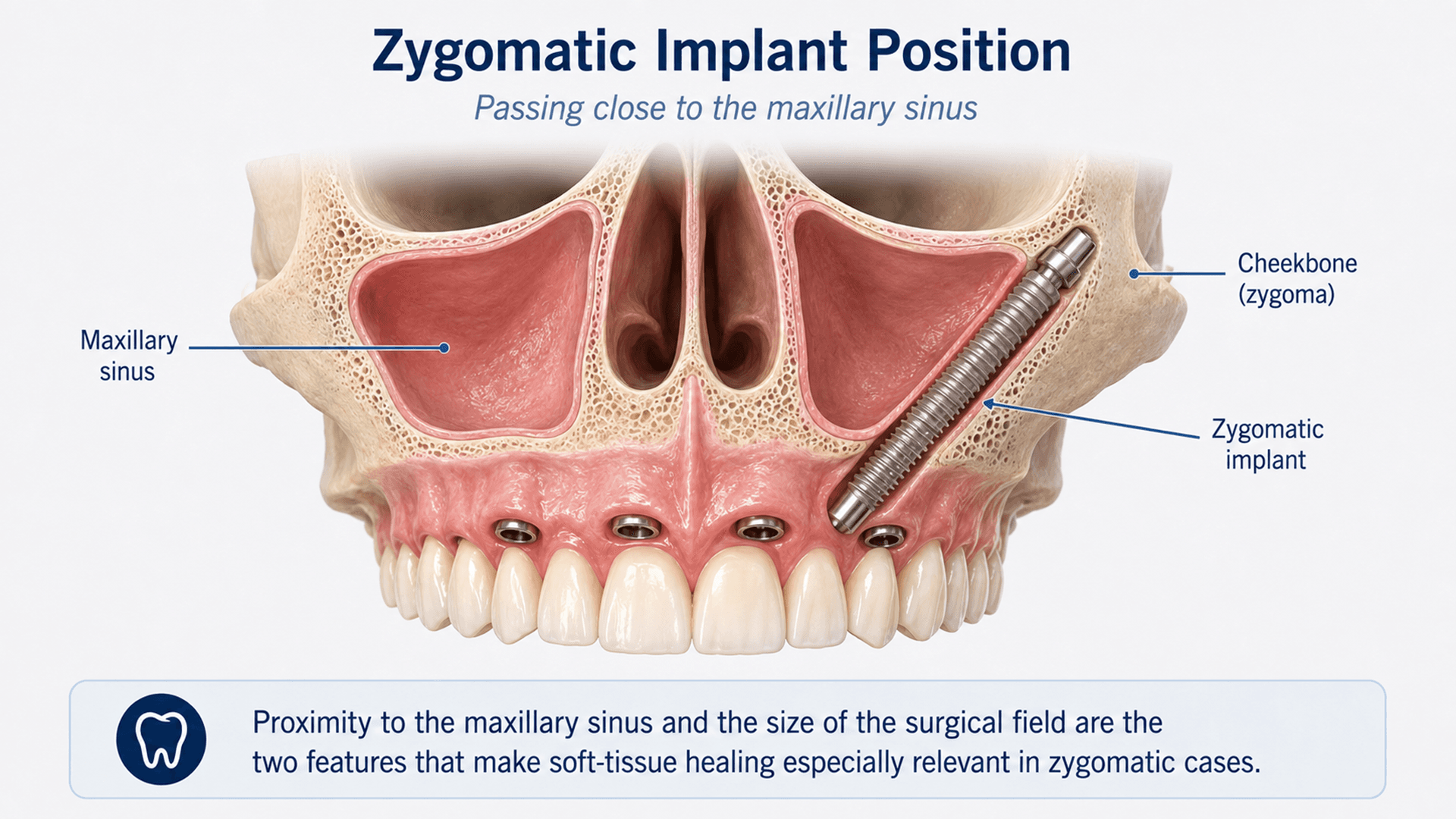
Sinus proximity. Zygomatic implants pass close to, or through, the maxillary sinus on their route to the cheekbone. Smoking is associated with impaired function of the mucous membrane that lines the airways and sinuses and with a higher background rate of sinus inflammation, and sinus complications are among the recognised risks of zygomatic surgery. Those two facts sit uncomfortably together.
A larger surgical field. A zygomatic protocol involves substantially more soft-tissue elevation and a longer procedure than a single implant, so there is simply more wound to heal and more tissue relying on good blood supply. The clinic protocol we hold describes surgery in the region of two to four hours under general anaesthesia or sedation. Anything that slows soft-tissue healing has more surface area to act on.
Soft-tissue healing around the prosthesis. The long-term health of a full-arch case depends heavily on the soft tissue around the implants staying healthy, because you cannot remove the bridge to clean under it. Smoking is associated with worse peri-implant soft-tissue outcomes, and that risk runs for years, not weeks. Our risks guide covers the complication picture in full.
Where smoking acts, stage by stage
General mechanisms described in clinical literature, not a prediction for your case. Your own surgeon assesses how these apply to you.
Last updated: July 2026| Stage | What smoking is associated with | Why it matters here |
|---|---|---|
| Before surgery | A raised baseline of gum inflammation and, in some patients, sinus inflammation | Pre-operative gum and sinus health form part of the assessment; problems found here may need treating first |
| Anaesthesia and the surgical day | Airway irritation and, in general surgical literature, a raised rate of respiratory events under anaesthesia | Relevant to a procedure of this length under general anaesthesia or sedation; a matter for the anaesthetist rather than the dentist |
| The first days and weeks | Reduced oxygen delivery to healing tissue and impaired wound healing; the physical suction and heat of smoking also act directly on the surgical site | This is the window every clinic is most concerned about, and the one where the effect is most immediate |
| Osseointegration (months 1 to 6) | Less predictable bone-to-implant integration reported in smokers | Typical protocols allow around four to six months for integration before the final bridge, so this is a long exposure window |
| Long term (years) | More peri-implant bone loss and a higher rate of peri-implant disease | The reason smoking often appears in written guarantee conditions rather than only in pre-operative advice |
Associations reported in clinical literature, summarised in general terms and awaiting citation. None of this establishes what will happen in an individual case.
Stopping before and after: what clinics typically ask
Almost every clinic that does this work will ask you to stop smoking for a period before surgery and for a period afterwards. What we are not going to do is print a number of weeks, because the figure varies between clinics and between published guidance documents, and inventing a specific one would be exactly the kind of fake precision this site exists to avoid. ``
What is consistent is the shape of the request. Clinics generally want a smoke-free window before surgery, on the basis that some of the effects on tissue oxygenation and airway irritation begin to reverse relatively quickly once you stop, and a longer smoke-free window after surgery, covering the period of active wound healing at minimum. Some clinics extend the request across the whole integration period before the final bridge is fitted. ``
The useful move is therefore not to search for the magic number but to ask your clinic three specific things: how long before, how long after, and what happens if you cannot manage it. A clinic with a considered answer to the third question is telling you something reassuring about how they practise. One that has clearly never thought about it is telling you something too. Our guide to checking a zygomatic surgeon has more questions in that vein.
The questions people actually search for, answered directly
No judgement in these answers, and no pretending the answers are more certain than they are.
When can I smoke again after a dental implant?
Is light smoking after an implant less risky than heavy smoking?
Can you smoke if you have dental implants long term?
I smoked once by accident during healing. Have I ruined it?
What about cigars, pipes, shisha and cannabis?
Will the clinic be able to tell if I smoke?
Vaping and nicotine replacement: where the evidence is thinner
This is the section where we have to be most careful, because the honest position is that the evidence is less settled than for cigarettes, and pages that state confident conclusions about vaping and implants are outrunning the data.
Vaping. What is reasonably established is that nicotine itself has vascular effects, and that the aerosol involves heat and inhalation at the surgical site. What is not established, to the level of certainty that would let us make a firm statement here, is how vaping compares quantitatively with smoking for implant outcomes — the research is younger and less consistent. The prudent reading, and the one many clinics take, is that vaping is not assumed to be neutral during healing. Ask your surgeon what they advise about it specifically, rather than assuming that switching means the restrictions no longer apply.
Nicotine replacement therapy. Patches, gum, lozenges and sprays deliver nicotine without combustion, tar or heat at the surgical site, which is a meaningful difference from smoking. UK stop-smoking services use these routinely, and whether they suit you around surgery is a question for your GP, pharmacist or stop-smoking adviser together with your surgeon — not something to decide from a web page.
Heated tobacco. Thinner still on implant-specific evidence. Treat any claim of reduced risk in this context as unproven and disclose use to your clinicians.
What being a smoker changes — and what it does not
Written to correct two opposite misconceptions we see constantly: that smoking rules you out entirely, and that it makes no practical difference.
What it does not usually change
- It is usually not an automatic refusal — most clinics assess smokers rather than turning them away
- It does not remove your right to a full assessment, a CBCT scan and a proper explanation of your options
- It does not make the treatment pointless; smokers do have successful implant treatment
- It does not oblige you to have quit before your first consultation — that conversation is a good place to start, not a test to pass
- It does not change the fact that your anatomy, assessed on a scan, is what determines whether zygomatic anchorage is even relevant
What it does change
- It raises the risk of implant failure and of healing complications, measurably and in the same direction across the literature
- It may change the protocol — some surgeons adapt loading, antibiotic or follow-up plans where healing risk is elevated
- It commonly appears in written guarantee and warranty conditions, which may be reduced or void for continued smoking
- It makes the pre-operative gum and sinus assessment more likely to find something that needs treating first
- It raises the value of strict hygiene and more frequent professional maintenance for the life of the implants
- It is relevant to the anaesthetist as well as the surgeon for a procedure of this length
A workable sequence if you smoke and want this treatment
Built around getting support in place early, because the free help in the UK works better with time than with willpower alone.
- 1
Say so at the first conversation
Tell every clinic you approach that you smoke, and how much, before you get a plan or a price. It costs you nothing and it lets you compare how seriously each of them treats it. A clinic that shrugs is not doing you a favour.
- 2
Get the stopping window in writing
Ask how long before surgery, how long after, and what they would advise about vaping and nicotine replacement in your case. Put it in the treatment plan rather than in a WhatsApp message. ``
- 3
Line up free NHS support before you set dates
Local NHS stop-smoking services and the NHS Better Health resources offer behavioural support and access to stopping aids, and evidence broadly supports combining support with medication over going it alone. Your GP or a pharmacist can point you to what is available in your area. Doing this before you book flights gives you room to work with.
- 4
Have the gum and sinus assessment done properly
Expect a thorough look at your gums and, on the CBCT, your sinuses. If something needs treating first, that is the plan working, not a setback. See how assessment fits the wider procedure.
- 5
Plan the post-operative period realistically
Decide in advance what you will do about cravings during the days when you are swollen, uncomfortable and at home. Having patches, gum or a support contact already in place beats improvising on day two. Our recovery guide covers what those days are usually like.
- 6
Build maintenance into the long term
Agree a hygiene and review schedule with your clinic that reflects your risk rather than the standard template, and arrange a UK dentist or hygienist for routine care between visits.
Questions to ask the clinic if you smoke
Ask these of any provider, in the UK or abroad. The quality of the answers tells you a great deal.
- 1Given that I smoke, do you consider me a candidate, and what would change your answer?
- 2How long do you ask patients to stop before surgery, and for how long afterwards — and why those periods? ``
- 3What do you advise about vaping and nicotine replacement in my case specifically?
- 4Does anything in your surgical or loading protocol change for a smoker?
- 5How does smoking affect the guarantee on my implants and bridge — can I see that in writing?
- 6What hygiene and review schedule would you recommend for me long term, and how does it differ from a non-smoker's?
- 7What signs during healing should make me contact you urgently?
- 8Under what circumstances would you postpone or decline my surgery?
Frequently asked questions
Does smoking affect dental implants?
What is the dental implant success rate in smokers?
Will a clinic refuse me because I smoke?
How long before surgery should I stop smoking?
When can I smoke after a dental implant?
Is vaping safer than smoking for dental implants?
Why does smoking matter more for zygomatic implants than for a normal implant?
How we reviewed this page
Written by the ZygomaticImplant.net editorial team and checked against the published literature. What we accept as a source, the difference between a page that is cited and one that is clinically signed off, and how we handle corrections are all set out in our editorial standards.
- First published
- 10 August 2026
- Last revised
- 21 August 2026
- Cited sources
- 5
- Clinical sign-off
- Pending · 57 statements queued
Sources & references
- [1]Calciolari E, Corbella S, Dourou M, Ercal P, Donos N. Tobacco Smoking and Smoke-Free Products as Risk Factors for Dental Implants: A Systematic Review. Clin Oral Implants Res. 2026;37(3):262–286. Reviewed 41 studies with follow-up from 1 to 17 years; found significantly reduced implant survival in cigarette smokers (OR 0.40, 95% CI 0.27–0.61) and an increased crestal bone loss of 0.64 mm. Concludes that smoking "is not considered an absolute contraindication for implant therapy" but has a detrimental effect on peri-implant tissues.
- [2]Mustapha AD, Salame Z, Chrcanovic BR. Smoking and Dental Implants: A Systematic Review and Meta-Analysis. Medicina (Kaunas). 2021;58(1):39. Pooled 292 publications covering 35,511 implants in smokers and 114,597 in non-smokers: failure odds ratio 2.402 (95% CI 2.176–2.652) and a mean marginal bone loss difference of 0.580 mm. The effect was strongest in the upper jaw (maxilla OR 2.910), which is the region zygomatic implants are used to rehabilitate.
- [3]Chen H, Liu N, Xu X, Qu X, Lu E. Smoking, Radiotherapy, Diabetes and Osteoporosis as Risk Factors for Dental Implant Failure: A Meta-Analysis. PLoS One. 2013;8(8):e71955.
- [4]Leeds Teaching Hospitals NHS Trust, Restorative Department Referral Protocols — Dental Implants (July 2024). An example of published NHS hospital criteria: patients who are current smokers are among those not offered implant treatment. Individual NHS trusts publish their own criteria and these vary by region.
- [5]NHS Better Health — Quit Smoking. Free NHS stop-smoking support, including local services and nicotine replacement guidance.
- [6]Smoking, mucociliary function and maxillary sinus health specifically in the context of zygomatic implant sinus proximity — we could not identify a study addressing this combination directly. The general smoking evidence above should not be read as sinus-specific.pending confirmation
- [7]Peri-operative guidance on smoking and general anaesthesia for procedures of this duration — anaesthetic source still to be confirmed.pending confirmation
- [8]Surgical duration (around two to four hours under general anaesthesia or sedation) and the four to six month interval to the final bridge — indicative protocol, not yet confirmed in writing by the clinic.pending confirmation
- [9]Clinic and manufacturer guarantee conditions relating to smoking — awaiting written guarantee terms.pending confirmation
- [10]This page is for information only and is not a substitute for professional medical or dental advice, diagnosis or treatment. It cannot assess your individual case.
The next step is a scan, not a decision
Upload a panoramic X-ray or CT scan and a specialist will tell you what is actually possible in your case — in writing, with no obligation.
Medically reviewed · Free · No pressure, no spam

