
Zygomatic Implants in Turkey: What to Know Before You Travel
Zygomatic implants in Turkey are typically offered as a two-trip package at a substantially lower price than UK private treatment, with the trade-off falling on aftercare and on who handles a complication once you are home. Most UK patients who look into this are not bargain-hunting: they have been quoted £15,000–£20,000 privately, told the NHS will not fund it, and found that the surgery is offered by a small number of clinicians at home. This page covers what the cost difference really is, what a package does and does not cover, how aftercare works from 2,000 miles away, and the reasons you might sensibly decide not to go.
- What the volume in Turkey does and does not mean
- “Turkey teeth” — what actually went wrong
- The downsides of treatment abroad, stated plainly
 Medically reviewed by Uzm. Dt. Oğuzhan SunarSpecialist PeriodontistUpdated August 2026 · 11 min readWritten from 9 cited sources · clinical sign-off pendingPublished by Natural Clinic · how this guide is funded
Trips needed
2
Illustrative photography — not a patient of any clinic.
Trips needed
2
Stay per trip
5–7 days
indicative
Typical saving
60–70%
Aftercare
Remote 4–6 months
Why Turkey became the highest-volume destination
Turkey did not become a dental destination by accident. Several things happened at once: a large number of dental graduates and maxillofacial surgeons relative to domestic private demand, sustained currency devaluation that made Turkish-priced services markedly less expensive in sterling, a mature private hospital sector already serving international patients, and heavy state and commercial promotion of health tourism. Add a three-and-a-half to four-hour flight from most UK airports and you have the conditions for very high volume.
For full-arch implant work specifically, that volume matters in one legitimate way. Advanced procedures have a learning curve, and zygomatic implant placement has a notably steep one — it is performed alongside the maxillary sinus and below the orbit, and the published literature ties outcomes closely to operator skill. The 2023 ITI consensus report describes zygomatic implants as "a complex treatment" whose success "is highly dependent on the clinician skill and experience"; a 2021 overview of systematic reviews puts it more strongly still, concluding that the procedure "should be reserved only to professional clinicians with vast surgical experience and a good knowledge of the 3D anatomy". A surgeon doing several of these cases a week is in a different position from one doing several a year. [1] [2]
What that volume does not mean is that any clinic in Turkey is experienced in this operation. The overwhelming majority of Turkish dental tourism is crowns, veneers and conventional implants. Zygomatic surgery sits in a small subset of clinics with maxillofacial surgeons and hospital-grade anaesthetic facilities. National statistics tell you nothing about the individual who will operate on you, and the concentration argument only works if you verify that you are actually inside that subset. That verification is your job, and the checklist further down is how you do it.
It is also worth saying plainly: the UK has excellent zygomatic surgeons. The constraints at home are price and, in some regions, availability and waiting times — not competence. Nobody should travel because they believe UK dentistry is poor.
"Turkey teeth": what actually went wrong
If you have seen the coverage — the national press reports, the dental profession’s warnings, the before-and-after pictures of unnaturally white, oversized teeth — you should know what the great majority of those cases actually were, because it changes how much of the story applies to you. A 2025 British Dental Journal review of 131 UK newspaper articles found that 92.4% of this coverage ran in tabloids, and that the reporting largely failed to distinguish dental tourism driven by problems accessing care at home from treatment sought for purely cosmetic reasons. Its authors argue the "#TurkeyTeeth" label, which has attracted hundreds of millions of social media views, has become shorthand in a way that is "both unfair and inappropriate". [3]
Almost all of those cases involved crowns or veneers placed on healthy natural teeth. Patients wanting a cosmetic transformation had sound teeth filed down aggressively — in the worst cases into the dentine or the pulp — to make room for a full set of crowns fitted in under a week. The predictable consequences followed: nerve damage, root canal treatment, abscesses, teeth that later had to be extracted, and irreversible loss of tooth structure in people whose teeth had been fine to begin with.
The professional concern behind the headlines is real, though. A 2022 British Dental Association survey of 1,000 UK dentists found that 94% had examined patients who had travelled abroad for dental treatment, and that 86% of those had treated cases which developed problems afterwards. Crowns were the treatment most likely to need follow-up work (87%), closely followed by implants (85%). Of the dentists reporting remedial work, 65% said it cost the patient at least £500 and 51% said more than £1,000, with one in five reporting costs above £5,000. Read that as a warning about aftercare and case selection, not as a verdict on every clinic in the country. [4]
That is a fundamentally different procedure from zygomatic implant surgery, and it is important to be precise about why. Those patients had healthy teeth destroyed for cosmetic reasons. If you are reading this page, you have most likely already lost your upper teeth and been told there is not enough bone to replace them. Nothing healthy is being sacrificed, the motivation is function rather than appearance, and the treatment is oral surgery performed by a maxillofacial surgeon rather than cosmetic dentistry.
But it would be dishonest to file the whole episode under "not my problem", because the systemic failures behind those cases apply to any treatment abroad. Aggressive social-media marketing. Prices quoted before anyone has examined you. Consent gathered in a hurry in a second language. Timelines compressed to fit a holiday. Nobody accountable once you are home. Those are risks of the model, not of the country, and they attach to major surgery far more seriously than to crowns. What happens if a zygomatic implant fails sets out the aftercare position in detail, including where the NHS will and will not step in.
The realistic cost difference
Indicative market ranges, shown so you can see the scale of the gap rather than to price your case. Clinics in Turkey typically quote full-arch work as an inclusive package; UK practices typically itemise.
Last updated: July 2026| Treatment | UK typical range | Turkey typical package |
|---|---|---|
| Full-arch zygoma (2 zygomatic + 2–4 standard implants, upper jaw, bridge included) | £15,000–£20,000 | from £5,500 |
| Quad zygoma (4 zygomatic implants, bridge included) | £20,000–£28,000 | from £7,500 |
| Single zygomatic implant added to a plan | £4,000–£6,000 | from £1,900 |
| Pterygoid implant added to a plan | £2,500–£4,000 | from £1,200 |
| CBCT scan + treatment plan | £150–£400 | Usually free (assessed remotely) |
Prices are indicative ranges, not quotes, and your final price depends on your CT scan and treatment plan. All figures are indicative ranges rather than quotes — confirm any price in writing. Last updated July 2026. Flights are not included in Turkish package prices — budget for two return trips for you and, if you need one, a companion. See our full cost breakdown and UK pricing page.
On those figures the gap on a full arch is substantial — often five figures. Before treating it as your saving, add the costs that sit outside the package: two sets of return flights, travel insurance that will actually cover elective surgery abroad (many standard policies will not), any extra hotel nights if healing is slower than planned, time off work, and the cost of any treatment you need from a UK dentist afterwards, which you will be paying for privately. The gap usually survives all of that. It is simply smaller than the headline.
What a package typically includes — and excludes
Inclusions vary between clinics and change over time, so treat this as the shape of a typical offer and insist on your own itemised list in writing. The items below are drawn from a typical package specification and are not confirmed for any particular clinic.
Usually included
Usually excluded
The items to pin down explicitly
Implant systems and prosthetics
Written warranty terms
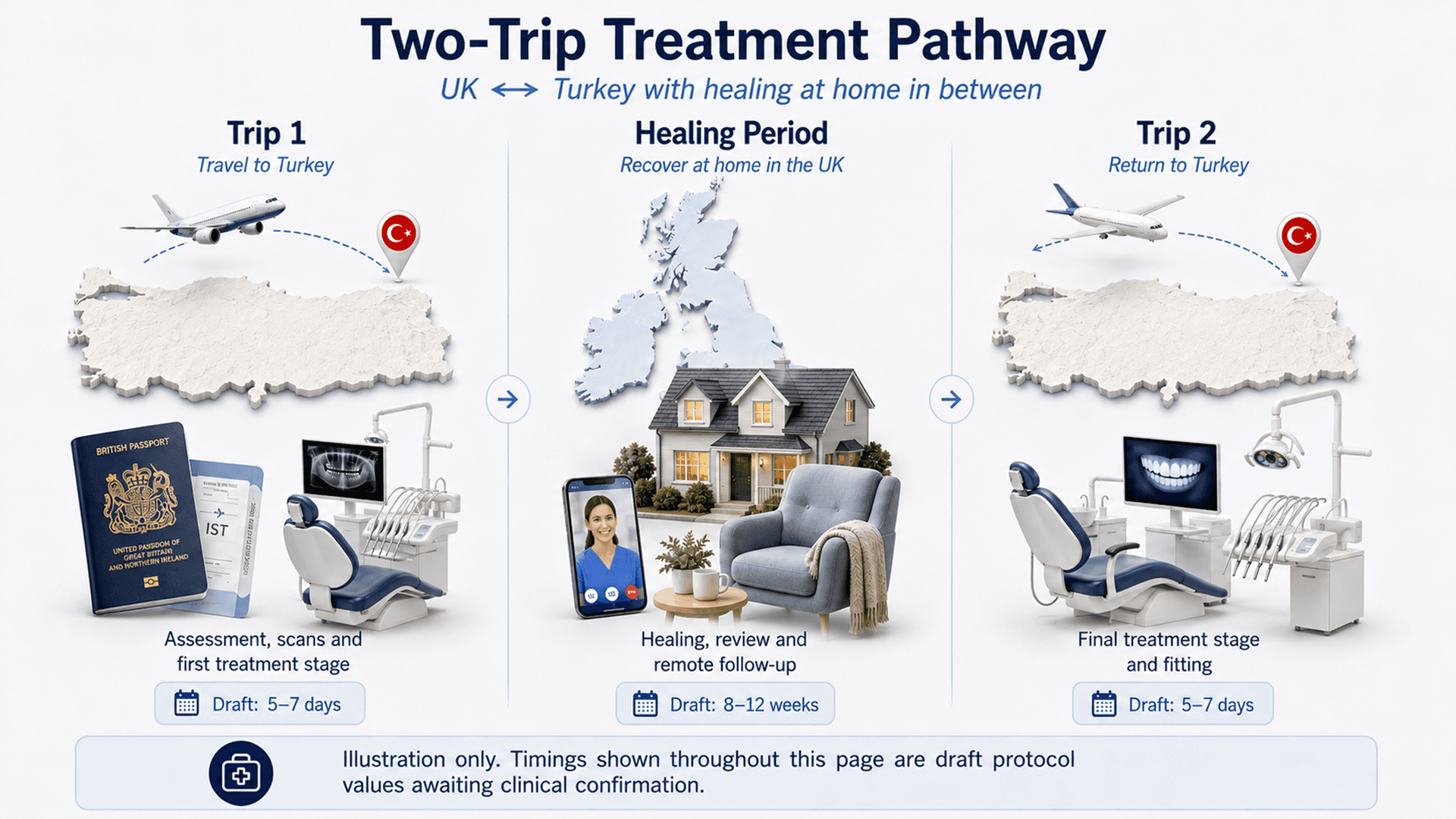
The two-trip protocol
Full-arch zygomatic treatment abroad is normally structured as two trips separated by several months of healing at home. Durations below are indicative and not confirmed for any particular clinic.
- 0
Remote assessment, before you book anything
You send a panoramic X-ray or, better, a CBCT scan. A surgeon reviews it and you receive a written treatment plan and quote. This stage is normally free. Any clinic willing to confirm suitability for zygomatic implants without seeing a scan has told you something important about itself.
- 1
First trip — 5 to 7 days
In-person examination and an on-site CBCT to confirm the plan, then surgery under general anaesthesia or deep sedation, typically lasting around 2–4 hours. A fixed provisional bridge is usually attached within 24–72 hours, and you are reviewed before discharge.
- 2
Flying home
You travel home within days of major maxillofacial surgery, with facial swelling and bruising at or near their peak. This is one of the genuine costs of treating abroad rather than a detail — see the honest assessment below, and ask your surgeon specifically when they consider you fit to fly.
- 3
Healing at home — roughly 4 to 6 months
Osseointegration takes place while you wear the fixed provisional bridge. Follow-up is remote: photographs, video calls and the aftercare line. You will want a UK dentist willing to see you locally during this window, and you should arrange that before you travel rather than after.
- 4
Second trip — 5 to 7 days
Impressions and fitting of the final bridge, commonly monolithic zirconia. Expect several appointments across the week for fitting and adjustment.
- 5
Long-term maintenance, in the UK
A full-arch implant bridge needs regular professional maintenance for the rest of its life, and that will realistically happen at home. Establish who will do it, and what they will charge, before you commit to the plan.
The honest balance
Both columns are real. Anyone presenting only one of them is selling something.
Genuine advantages
- A cost difference that is frequently five figures on a full arch
- High case volume in a small number of clinics, which for a technique this specialised is a meaningful factor
- Treatment usually starting within weeks rather than after a long wait
- Surgery, provisional bridge and logistics coordinated as a single package
- Short flight and no time-zone disruption from the UK
- Interpreting and coordination handled for you, which matters more than it sounds when you are recovering
Genuine disadvantages
- You fly home while swollen and sore, days after major surgery under general anaesthesia
- Your surgeon is 2,000 miles away for the entire 4–6 month healing period
- If something goes wrong at 3am in the UK, the response is a message, not an appointment
- Complications may need treating locally, at your own cost, by a dentist who did not do the surgery
- Legal recourse is harder: you are outside the GDC and the Dental Complaints Service, and any claim runs through the Turkish regulator and courts
- Some UK dentists are reluctant to take on the aftercare of implant work done abroad, which you should establish before travelling, not after
- Two trips, two sets of flights, and time off work that partly offsets the saving
- Quality varies enormously between clinics, and the marketing gives you almost no way to tell them apart
UK vs Turkey on the things that matter
Cost is only one of four columns, and it is not the one that determines whether you end up satisfied.
| Treatment in the UK | Treatment in Turkey | |
|---|---|---|
| Cost, full-arch zygoma | £15,000–£20,000, up to £28,000 for quad zygoma | Packages from £5,500, from £7,500 for quad zygoma, flights excluded |
| Travel burden | Domestic travel; you sleep in your own bed the night after discharge | Two return trips of 5–7 days each; you fly home within days of surgery |
| Aftercare proximity | Your surgeon is reachable and can see you in person throughout healing | Remote follow-up by message and video for 4–6 months; in-person review means flying back |
| Handling complications | Managed by the team that operated, usually within their fee | Managed remotely, or locally at your own cost, or by returning to Turkey |
| Regulation and recourse | GDC-registered clinicians; Dental Complaints Service for private care; UK courts | Turkish regulator and courts; UK bodies have no jurisdiction; check your insurance covers elective surgery abroad |
| Continuity of records | One clinical record, held locally, accessible to whoever treats you next | Records held abroad; insist on scans, surgical notes and the implant passport in writing before you leave |
Prices are indicative ranges, not quotes, and depend on your CT scan. Last updated July 2026. All figures are indicative ranges rather than quotes — confirm any price in writing.
Questions to ask any clinic, at home or abroad
These are deliberately the same questions wherever you are treated — the standards that matter do not change with the country. Ask them in writing and keep the replies. A clinic that answers all fourteen clearly has told you a great deal about itself; so has one that deflects.
- 1Who exactly will perform the surgery, and what specialty are they registered in — with documented zygomatic training?
- 2How many zygomatic cases does that individual surgeon complete each year?
- 3Can I see their registration details and speak to them, not only to a coordinator, before I commit?
- 4Which zygomatic implant system do you use, and can you send me the manufacturer documentation?
- 5Will I receive an implant passport with batch numbers, plus my scans and surgical notes, before I fly home?
- 6Will you produce a CBCT-based plan before I pay anything, and will you talk me through it?
- 7Is the surgery performed in a hospital or a clinic, and who provides the anaesthesia?
- 8What exactly does the package include, and what is excluded? Please itemise it.
- 9What happens, clinically and financially, if an implant fails to integrate?
- 10What happens if the plan turns out not to be feasible once surgery has started?
- 11How are complications handled once I am home, and who pays for treatment I need in the UK?
- 12When do you consider me fit to fly after this surgery?
- 13What are the written warranty terms and their conditions?
- 14Can I speak to previous zygomatic patients — not veneer patients — from the UK?
Aftercare, honestly
This is the part of treatment abroad that is consistently undersold, so it is worth being blunt. For four to six months after surgery you will be healing in the UK while the people who operated on you are in Turkey. In an uncomplicated case that is genuinely manageable: swelling settles over the first weeks, the provisional bridge does its job, photographs and video calls are enough for review, and you fly back once for the final teeth.
The problem is that complications do not schedule themselves around trips. Sinus problems are the most commonly reported complication of zygomatic implants, and they may need assessment and antibiotics locally. A provisional bridge can fracture or loosen. An implant may fail to integrate. None of these is a catastrophe, but each needs someone to look inside your mouth — and a remote coordinator, however responsive, cannot do that. The recovery guide describes what those months normally involve.
So the practical step is this: before you book anything, find a UK dentist willing to be your local point of contact and check reviews, and ask what they charge. Some are happy to; some decline to take on work they did not do. Discovering which after you have flown home is the wrong order. Our recovery guide sets out what normal healing looks like week by week, and the risks page covers what does not.
Finally, be realistic about who is a good candidate for treatment abroad at all. If you have significant heart or lung disease, a bleeding disorder, poorly controlled diabetes, or a history of thrombosis, the flights and the distance from your surgeon are additional risks stacked on top of an already advanced operation. That case may be better done at home even at four times the price. Discuss it with your GP rather than only with a clinic.
Frequently asked questions
How much do zygomatic implants cost in Turkey?
Is "Turkey teeth" the same thing as zygomatic implants?
How many trips to Turkey does zygomatic treatment need?
What happens if something goes wrong when I am back in the UK?
Can I complain or claim compensation if treatment abroad goes wrong?
What should I verify about the surgeon and the implant system?
Is it safe to fly home so soon after the surgery?
How we reviewed this page
Written by the ZygomaticImplant.net editorial team and checked against the published literature. What we accept as a source, the difference between a page that is cited and one that is clinically signed off, and how we handle corrections are all set out in our editorial standards.
- First published
- 10 August 2026
- Last revised
- 21 August 2026
- Cited sources
- 9
- Clinical sign-off
- Pending · 32 statements queued
Sources & references
- [1]Al-Nawas B, Aghaloo T, Aparicio C, et al. ITI consensus report on zygomatic implants: indications, evaluation of surgical techniques and long-term treatment outcomes. Int J Implant Dent. 2023;9:28. Source of the statement that zygomatic implants are "a complex treatment" whose success "is highly dependent on the clinician skill and experience", and of the 96.2% mean survival and 14.2% sinusitis prevalence figures.
- [2]Ramezanzade S, Yates J, Tuminelli FJ, Keyhan SO, Yousefi P, Lopez-Lopez J. Zygomatic implants placed in atrophic maxilla: an overview of current systematic reviews and meta-analysis. Maxillofac Plast Reconstr Surg. 2021;43(1):1. Concludes that the treatment "should be reserved only to professional clinicians with vast surgical experience and a good knowledge of the 3D anatomy".
- [3]Doughty J, Moore D, Ellis M, et al. Contemporary dental tourism: a review of reporting in the UK news media. Br Dent J. 2025;238(4):230–237. Analysis of 131 articles from the ten most widely read UK newspapers; found 92.4% of coverage in tabloids and criticised the failure to separate access-driven from purely cosmetic dental tourism.
- [4]British Dental Association. UK dentists picking up the pieces from dental tourism boom, 14 July 2022. Survey of 1,000 UK dentists: 94% had examined patients treated abroad, 86% of those had treated resulting problems, crowns (87%) and implants (85%) most often needed follow-up, and remedial costs exceeded £1,000 for 51% of reporting dentists.
- [5]Molinero-Mourelle P, Baca-Gonzalez L, Gao B, Saez-Alcaide LM, Helm A, Lopez-Quiles J. Surgical complications in zygomatic implants: a systematic review. Med Oral Patol Oral Cir Bucal. 2016;21(6):e751–e757. Reported sinusitis rates vary widely between published series, which is why no single percentage is quoted on this page.
- [6]General Dental Council. Going abroad for dental treatment. The GDC registers dental professionals working in the UK and advises that it "can't guarantee another organisation like us exists in other countries, or even that the standards will be the same", and that patients should speak to their own dentist before travelling "in case of any later complications".
- [7]NHS England. Avoidance of doubt: Clinical policy for self-funded dental treatment requiring NHS intervention. Published 4 November 2024. Patients are entitled to NHS assessment and stabilisation of an acute problem, but self-funded care the NHS would not routinely fund "would not usually be offered or replaced once stabilisation has been achieved".
- [8]UK Civil Aviation Authority, Surgical conditions (guidance for health professionals). Sets out post-operative flying advice and the gas-expansion principle behind it — for example approximately seven days after neurosurgery and ten days after abdominal surgery. The CAA guidance does not give a maxillofacial or sinus-specific interval, so the timing for this operation must come from your operating surgeon rather than from published general advice.
- [9]Competition and Markets Authority, private dental services market study (opened 2026), examining pricing transparency in UK private dentistry. No central register of UK private dental fees is published, so UK ranges on this page are compiled from publicly advertised clinic prices rather than an independent fee survey.
- [10]Turkish health tourism volumes, dental workforce data and pricing context. We could not verify these figures against a primary official source: USHAŞ, the Turkish Ministry of Health agency responsible for international health services, does not publish patient-volume statistics on its public health tourism pages, and the figures circulating online come from commercial secondary sources that do not agree with one another. No specific volume claim is therefore made on this page.pending confirmation
- [11]Turkey package prices and inclusions — indicative figures dated July 2026, not yet confirmed in writing by the clinic.pending confirmation
- [12]Two-trip protocol timings, anaesthesia approach and provisional bridge timing — indicative, not yet confirmed in writing by the operating surgeon.pending confirmation
- [13]Warranty terms for the implant body and the prosthetic work — indicative, not yet confirmed in writing by the clinic and awaiting legal review.pending confirmation
- [14]Your legal position and routes to redress if treatment received outside the UK goes wrong — including which regulator, if any, you can complain to and whether a UK claim is possible. The GDC and NHS England sources above set out the UK regulatory and NHS-funding position, but the cross-border liability question is a legal one and is awaiting review by a qualified adviser. Do not rely on this page for it.pending confirmation
- [15]Medical review: our reviewing clinician has not yet signed off every clinical statement on this page. The badge beside the byline at the top shows how many statements have been confirmed so far.pending confirmation
The next step is a scan, not a decision
Upload a panoramic X-ray or CT scan and a specialist will tell you what is actually possible in your case — in writing, with no obligation.
Medically reviewed · Free · No pressure, no spam
Related guides

Zygomatic Implants in the UK: Options, Costs & NHS
Read
Zygomatic Implant Costs: UK vs Abroad
Read
Zygomatic Dental Implants: The Complete Guide
Read
Zygomatic Implants: Success Rates, Risks & Complications
Read
Zygomatic Implant Recovery & Aftercare
Read
Dental Implants With Severe Bone Loss: All Your Options
Read
Teeth in a Day With Zygomatic Implants: What It Really Means
Read
How to Find a Zygomatic Implant Surgeon
ReadWhen a Zygomatic Implant Fails: Signs, Removal and Revision
Read