
Dental Implants With Severe Bone Loss: All Your Options
When there is too little jawbone for standard implants, the realistic routes are to rebuild the bone (grafting or a sinus lift), to work around it (short, narrow, tilted, zygomatic or pterygoid implants), or to stay with a removable denture. If a dentist has told you there is not enough bone in your jaw for implants, that sentence can feel final. It usually is not. This guide explains why the jaw shrinks, how a clinician actually measures it, and what each option genuinely involves, including the trade-offs nobody enjoys mentioning.
- Every route compared, grafting included
- Why the jaw shrinks — and what that rules out
- What to ask when a clinic says no
 Medically reviewed by Uzm. Dt. Oğuzhan SunarSpecialist PeriodontistUpdated August 2026 · 11 min readWritten from 7 cited sources · clinical sign-off pendingPublished by Natural Clinic · how this guide is funded
Routes compared
7
Illustrative photography — not a patient of any clinic.
Routes compared
7
Graft healing
6–12+ months
indicative
Graftless options
Zygoma, pterygoid
Decided by
Your CBCT scan
Why the jawbone shrinks after tooth loss
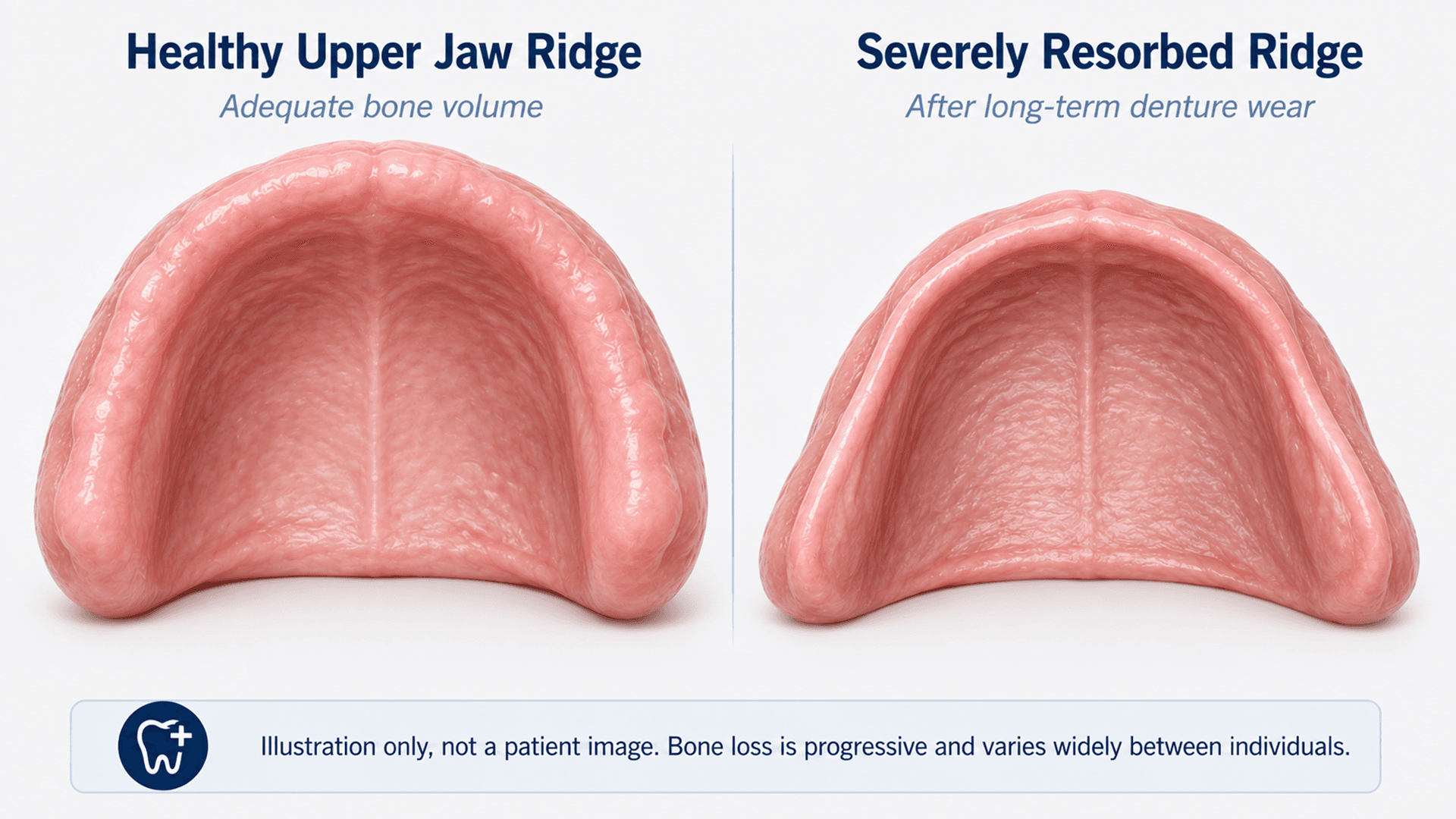
Jawbone is living tissue, and like muscle it responds to use. The forces travelling down a tooth root into the bone are what tell that bone to maintain itself. Once a tooth is removed, the bone that used to hold it — the alveolar ridge — loses its job and begins to remodel away. This process is called residual ridge resorption, and it starts within weeks of an extraction.
The loss is fastest in the first year and then continues more slowly, year after year. That is why the timeline matters so much: someone who lost their upper teeth two years ago is in a very different position from someone who has worn a full upper denture since their forties.
Dentures make the picture more complicated. A conventional denture rests on the gum and transmits chewing pressure straight onto the ridge rather than into it, which does nothing to preserve the bone underneath and, over years, is associated with continued shrinkage. Long-term denture wearers often describe the same sequence: the plate that fitted beautifully at first needs relining, then relining again, then simply will not stay put. The denture has not changed shape — the ridge under it has.
Two other causes account for much of the rest. Advanced gum disease (periodontitis) destroys the bone around teeth that are still present, so bone can already be lost before the teeth even come out. And in the upper jaw, the maxillary sinus sits directly above the back teeth; once those teeth are gone, the sinus floor tends to drop into the space, leaving very little height for an implant to be placed.
What "not enough bone" usually means
It is worth understanding what is actually being said, because the phrase is used loosely. A standard dental implant is roughly 8–15 mm long and needs to sit inside bone that is tall enough to hold that length and wide enough to surround it, with a safe margin from the sinus above and the nerves below. When a clinician says there is not enough bone, they usually mean one of three quite different things:
One: there is not enough bone for a standard implant *today*, but there is enough to graft — so bone can be added and implants placed later. Two: there is not enough bone for a standard implant anywhere in that part of the jaw, so a different anchorage point is needed. Three: implants of any kind are not advisable right now for medical reasons — uncontrolled diabetes, certain medications, active infection, heavy smoking — rather than because of the bone itself.
Those three sentences lead to three completely different conversations. If you are not sure which one you were given, that is the first thing to go back and ask.
How a clinician measures whether you have enough bone
No responsible assessment of bone volume happens by eye, and none happens over the phone. This is the sequence a thorough workup follows.
- 1
Clinical examination and history
How long the teeth have been missing, how long you have worn a denture, whether gum disease was involved, whether any previous implant or graft failed, plus general health, medication and smoking. These change what is advisable as much as the scan does.
- 2
Panoramic X-ray (OPG)
A single flat image of both jaws. It is a good screening tool — it shows roughly how much ridge height remains and where the sinuses sit — but it is a two-dimensional picture of a three-dimensional problem, and it cannot show width. It is a starting point, not a verdict.
- 3
CBCT scan
Cone-beam computed tomography produces a 3D reconstruction of your jaw. This is the measurement that actually decides things: height, width, bone density and the exact position of the sinuses, nerves and, for zygomatic planning, the cheekbones. Any clinic proposing advanced implant surgery should be planning from a CBCT.
- 4
Measuring the available bone
Using the CBCT, the surgeon measures usable bone height and width at each intended implant site in millimetres, and assesses bone quality. This is where a route is either ruled in or ruled out — and where you can reasonably ask to be shown the numbers on screen.
- 5
A written plan with alternatives
A thorough plan does not present one option. It should set out what is possible, what each route would involve, roughly how long each takes, and what it costs — including the option of doing nothing surgical at all.
Every route to teeth when bone is limited
Seven realistic options, side by side. None of them is the right answer for everyone, and the honest ranking depends entirely on how much bone you have left, where it is missing, your general health and what you are willing to go through. Costs are indicative UK ranges, not quotes.
Bone grafting + standard implants
Best for: Moderate, localised bone loss where the ridge can genuinely be rebuilt
- Bone needed
- Enough host bone for the graft to knit onto
- Extra grafting
- Yes — that is the whole point of it
- Time to finished teeth
- 6–12+ months, because the graft must heal before implants can be placed
- Indicative UK cost
- £14,000–£22,000+ including grafting
- Main trade-off
- The longest route and an extra surgical stage — but it rebuilds real bone, has decades of published evidence behind it, and leaves you with a conventional implant that any dentist can maintain
Sinus lift (sinus graft) + implants
Best for: Missing upper back teeth where the shortfall is height beneath the sinus
- Bone needed
- Reasonable width, with the deficit mainly in height under the sinus
- Extra grafting
- Yes — graft material placed beneath the lifted sinus lining
- Time to finished teeth
- Months of healing, either before or alongside implant placement depending on technique
- Indicative UK cost
- , on top of implant fees
- Main trade-off
- A well-established solution for the upper back jaw, but it only addresses that region — it does not help if the front of the jaw has collapsed too
Short or narrow implants
Best for: Mild to moderate loss where a shorter implant still finds solid bone
- Bone needed
- Reduced height, but decent width and bone quality
- Extra grafting
- Often none
- Time to finished teeth
- Comparable to standard implants
- Indicative UK cost
- Main trade-off
- Neatly avoids grafting in the right cases, but there is a floor below which there is simply not enough bone for any implant of any length
All-on-4 (tilted standard implants)
Best for: Mild to moderate loss with usable bone remaining at the front of the jaw
- Bone needed
- A minimum volume in the front section of the jaw
- Extra grafting
- Usually none
- Time to finished teeth
- Fixed provisional teeth usually within 24–72 hours, final bridge months later
- Indicative UK cost
- £10,000–£16,000
- Main trade-off
- Fast, widely available and a genuine step up from a denture — but it still depends on jawbone, which is exactly what severe resorption removes
Zygomatic implants
Best for: Severe upper-jaw bone loss, including cases where a graft or implants have already failed
- Bone needed
- None in the upper jaw itself — anchorage is in the cheekbone, which does not shrink after tooth loss
- Extra grafting
- No
- Time to finished teeth
- Fixed provisional teeth usually within 24–72 hours; final bridge after roughly 4–6 months of healing
- Indicative UK cost
- £15,000–£20,000, rising to around £28,000 for quad zygoma
- Main trade-off
- Skips months of grafting entirely, but it is advanced maxillofacial surgery near the sinus and eye socket, and outcomes depend heavily on the surgeon’s experience with zygomatic anatomy
Pterygoid implants
Best for: Rebuilding back-tooth support without a sinus graft
- Bone needed
- None in the upper back jaw — anchorage is in dense bone behind it
- Extra grafting
- No
- Time to finished teeth
- Usually placed in the same operation as the other implants
- Indicative UK cost
- £2,500–£4,000 per implant, added to a wider plan
- Main trade-off
- Avoids sinus grafting and extends the bridge further back, but it is a specialised technique offered by relatively few surgeons
Staying with dentures
Best for: Anyone not fit for, not ready for, or simply not wanting major surgery
- Bone needed
- None for a conventional denture; a modest amount for an implant-retained overdenture on two implants
- Extra grafting
- No
- Time to finished teeth
- Weeks
- Indicative UK cost
- The least expensive route by a wide margin
- Main trade-off
- No surgery, no recovery, and reversible — but the ridge underneath carries on shrinking, and a proportion of people never adapt comfortably to a loose upper plate
Bone grafting deserves a fair hearing
Because this site is about zygomatic implants, it would be easy to present grafting as the thing you are escaping. That would be misleading. Bone grafting is the most studied answer to bone loss in dentistry, it has been refined over decades, and it does something no graftless technique does: it rebuilds actual bone, so that afterwards you have a conventional implant in a conventional position that any implant dentist can maintain or revise. For localised defects it is often the most sensible plan by some distance.
Its honest cost is time and staging. Depending on the graft, you may be looking at a healing period measured in months before implants can be placed, then integration time after that, then the final teeth. Two or three surgical episodes is normal. Grafts can also fail to take, particularly in smokers, and a failed graft is a genuine setback rather than a neutral outcome.
The point at which grafting stops being the obvious choice is when there is too little host bone left to graft onto, or when the volume required is so large that the reconstruction becomes a bigger undertaking than the alternative. That is the territory where graftless techniques were developed — not as a better version of grafting, but as an answer for jaws where grafting had become impractical.
Grafting first vs graftless approaches
Set against each other as approaches rather than as products. Which column matters more to you is a personal judgement, not a clinical one.
Reasons people choose to graft
- Rebuilds real bone rather than working around the loss
- The longest published track record of any approach to bone loss
- Ends with standard implants in standard positions, which are easier to maintain and to revise later
- Available from a far wider range of clinics, including closer to home
- Often the lower-cost route when the defect is small and localised
- Keeps future options open, including implants placed by a different clinician years later
Reasons people choose a graftless route
- Avoids months of healing between stages — relevant if you have already spent years in dentures
- One operation instead of two or three, and one course of anaesthesia
- Possible where grafting is not, including after a graft has already failed
- Anchorage in bone that does not resorb after tooth loss
- Fixed provisional teeth typically fitted within days rather than after a year
- Removes the risk of the graft itself failing to integrate
Indicative costs for each route
Figures below are market ranges gathered for this guide, shown so you can see the shape of the decision. They are not quotes, and no clinic can price your case without a CBCT scan.
Last updated: July 2026| Route | UK typical range | Turkey typical package |
|---|---|---|
| Bone graft + standard implants (full arch) | £14,000–£22,000+ | — [no sourced figure yet] |
| All-on-4, standard implants (full arch) | £10,000–£16,000 | — [no sourced figure yet] |
| Full-arch zygoma (2 zygomatic + 2–4 standard, upper jaw, bridge included) | £15,000–£20,000 | from £5,500 |
| Quad zygoma (4 zygomatic implants, bridge included) | £20,000–£28,000 | from £7,500 |
| Single zygomatic implant added to a plan | £4,000–£6,000 | from £1,900 |
| Pterygoid implant added to a plan | £2,500–£4,000 | from £1,200 |
| CBCT scan + treatment plan | £150–£400 | Usually free (assessed remotely) |
Prices are indicative ranges, not quotes, and your final price depends on your CT scan and treatment plan. All figures are indicative ranges rather than quotes; a dash means we do not yet hold a sourced figure for that route rather than that the treatment is unavailable. Last updated July 2026. Full breakdown in our cost guide and UK pricing page.
Where an implant finds bone when the jaw has gone
A standard implant sits in the alveolar ridge of the jaw. A zygomatic implant passes through or alongside the sinus to anchor in the cheekbone — bone that is dense and does not shrink after tooth loss.
Situations readers ask about most
I was told I have no bone at all in my upper jaw.
I have already had a bone graft that failed.
Only my upper back teeth are missing.
Is it different in the lower jaw?
Can bone loss be reversed by anything other than surgery?
Does smoking or diabetes rule me out?
Will the NHS fund any of this?
What to ask when a clinic says implants are not possible
Take these to the practice that declined you, or to a second opinion. They are designed to separate "not possible for anyone" from "not something we do here" — which is the distinction that decides your next step.
- 1Is there not enough bone for a standard implant, or not enough bone for any implant at all?
- 2How was that measured — from a panoramic X-ray or from a CBCT scan?
- 3Can you show me the millimetre measurements at each site on the scan?
- 4Would grafting work in my case, and if not, why not?
- 5Which of these have you considered and ruled out: sinus lift, short implants, tilted implants, All-on-4, pterygoid implants, zygomatic implants?
- 6Which of those procedures does this practice perform in-house?
- 7If a technique you do not offer might work for me, who would you refer me to?
- 8Are there medical or lifestyle reasons in my case, separate from the bone itself?
- 9If I do nothing surgical, what happens to my jaw over the next five and ten years?
- 10What would you do if this were your own jaw?
Where zygomatic implants fit into this
Zygomatic implants are one option on the list above, not the end of it. They are extra-long implants — roughly 30–52.5 mm against the 8–15 mm of a standard implant — that pass through or alongside the maxillary sinus to anchor in the zygomatic bone, the cheekbone. Because the cheekbone does not resorb after tooth loss, they can support a full fixed upper bridge in a jaw that has nothing left to offer a conventional implant, and without grafting. They were developed in the late 1980s for patients who had lost jaw structure to cancer surgery or trauma, and have since become an established option for advanced resorption.
They also carry the risk profile of the surgery they are: sinus complications, infection, altered sensation in the cheek, rare but serious orbital injury, and implant failure. This is not a procedure every implant dentist performs, and the surgeon’s case volume is the single factor most worth interrogating. Read the honest version in our risks guide before you read anything else about them.
If your bone loss turns out to be moderate rather than severe, expect grafting or All-on-4 to be the better plan — and be sceptical of any clinic that arrives at zygomatic implants before it has seen your scan. If it is severe, start with the complete zygomatic implants guide, then what the procedure involves, what recovery is like and what treatment abroad really entails.
Frequently asked questions
Can you get dental implants with bone loss?
How much bone loss is too much for implants?
Do I definitely need a bone graft?
How much do dental implants with bone loss cost?
Can lost jawbone grow back on its own?
Why did one clinic say no when another said yes?
Is it too late if I have worn dentures for twenty years?
How we reviewed this page
Written by the ZygomaticImplant.net editorial team and checked against the published literature. What we accept as a source, the difference between a page that is cited and one that is clinically signed off, and how we handle corrections are all set out in our editorial standards.
- First published
- 10 August 2026
- Last revised
- 21 August 2026
- Cited sources
- 7
- Clinical sign-off
- Pending · 39 statements queued
Sources & references
- [1]Tallgren A. The continuing reduction of the residual alveolar ridges in complete denture wearers: a mixed-longitudinal study covering 25 years. J Prosthet Dent. 1972;27(2):120–132. The landmark longitudinal study showing that ridge resorption continues throughout denture wear rather than stabilising.
- [2]Al-Nawas B, Aghaloo T, Aparicio C, et al. ITI consensus report on zygomatic implants: indications, evaluation of surgical techniques and long-term treatment outcomes. Int J Implant Dent. 2023;9:28. Zygomatic implants are "mainly indicated in cases with maxillary bone atrophy or deficiency"; mean survival 96.2% over a mean 6.3-year follow-up, with sinusitis the most common complication at 14.2% prevalence.
- [3]Lorusso F, Conte R, Inchingolo F, Festa F, Scarano A. Survival Rate of Zygomatic Implants for Fixed Oral Maxillary Rehabilitations: A Systematic Review and Meta-Analysis Comparing Outcomes between Zygomatic and Regular Implants. Dent J (Basel). 2021;9(4):38. Reports a 12-year cumulative survival rate of 95.21% across 4,556 zygomatic implants in 2,161 patients.
- [4]Cucchi A, Maiani F, Franceschi D, Sassano M, Fiorino A, Urban IA, Corinaldesi G. The influence of vertical ridge augmentation techniques on peri-implant bone loss: A systematic review and meta-analysis. Clin Implant Dent Relat Res. 2024;26(1):15–65. Combined healing complication rate 15.9% (95% CI 11.7–20.4) and mean vertical bone gain 5.26 mm, varying widely by technique — useful context for weighing grafting against graftless options.
- [5]Brånemark P-I, Gröndahl K, Ohrnell L-O, Nilsson P, Petruson B, Svensson B, et al. Zygoma fixture in the management of advanced atrophy of the maxilla: technique and long-term results. Scand J Plast Reconstr Surg Hand Surg. 2004;38(2):70–85.
- [6]Leeds Teaching Hospitals NHS Trust, Restorative Department Referral Protocols — Dental Implants (July 2024). Sets out NHS hospital acceptance criteria — developmental disorders, trauma, head and neck cancer, and severe denture intolerance — together with exclusions applied to smokers and to active caries or periodontal disease. Criteria vary by NHS trust.
- [7]NHS England. Avoidance of doubt: Clinical policy for self-funded dental treatment requiring NHS intervention. Published 4 November 2024.
- [8]Professional guidance on the use of cone-beam CT in dental implant planning — reference still to be added.pending confirmation
- [9]UK private fee ranges for grafting, All-on-4, sinus lift, short implants, dentures and overdentures, and Turkey package prices — indicative figures compiled from advertised clinic prices and indicative figures, not an independent fee survey.pending confirmation
- [10]Medical review: our reviewing clinician has not yet signed off every clinical statement on this page. The badge beside the byline at the top shows how many have been confirmed so far.pending confirmation
The next step is a scan, not a decision
Upload a panoramic X-ray or CT scan and a specialist will tell you what is actually possible in your case — in writing, with no obligation.
Medically reviewed · Free · No pressure, no spam
Related guides

Zygomatic Dental Implants: The Complete Guide
Read
Zygomatic Implant Costs: UK vs Abroad
Read
Pterygoid Implants: The Other Graftless Option
Read
Quad Zygomatic Implants: Fixed Teeth With No Usable Jawbone
Read
Zygomatic Implants: Success Rates, Risks & Complications
Read
Zygomatic Implants in the UK: Options, Costs & NHS
Read
Bone Graft Alternatives for Dental Implants
ReadAm I a Candidate for Zygomatic Implants?
Read